Can You Dive Cenotes With Open Water in Mexico?
Yes—Open Water divers can dive many cenotes in Mexico on guided cavern tours within natural light zones and 130-200 ft of the surface.
Can I dive in cenotes with my Open Water Diver certification?
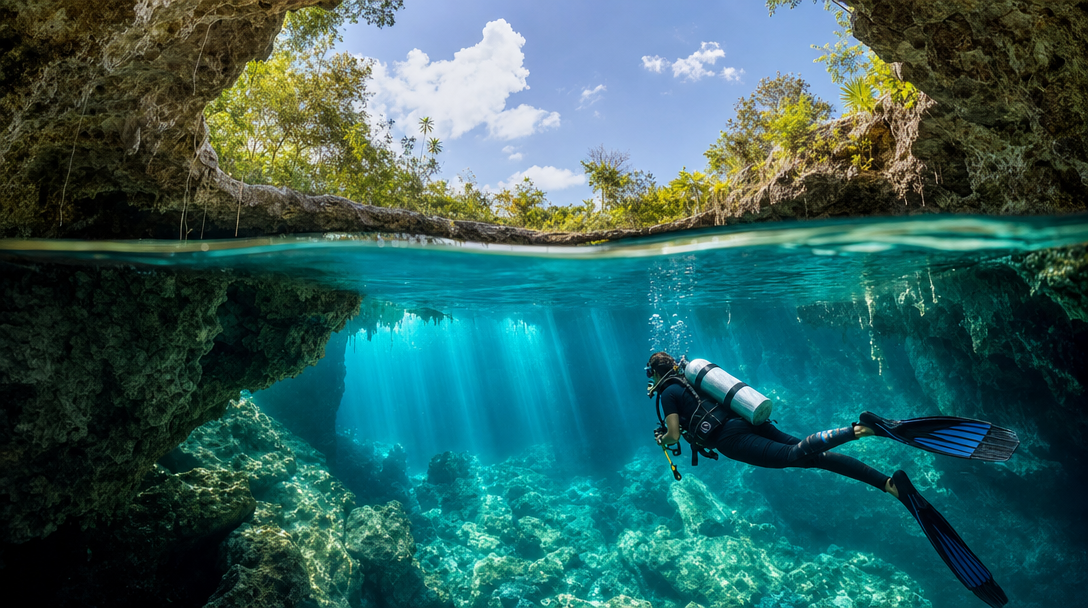
Yes, an Open Water Diver certification lets you dive many cenotes in Mexico, as long as the dive is a guided cavern tour that stays inside its limits. PADI confirms certified Open Water divers can join guided cavern tours that remain within the natural light zone and within 130 to 200 ft (39-60 m) of the surface (Source: PADI). Your card is enough for the right route, not for every route.
The detail that trips people up: "cenote diving" isn't one thing. Blue Life states that recreational cenote dives require at least an Open Water certification because they happen in the cavern zone, not in true cave passages. Cenote Dive Tour adds that Open Water divers can dive in caverns when a certified guide leads them along the cavern line after a clear briefing on navigation, air management, and communication signals.
So eligibility comes down to the specific dive, not the word on the brochure. A well-run operator matches you to a cenote your training covers, then keeps you inside it. If you tell Seth your certification level and recent dive history, you'll get a site recommendation that fits, not a generic "everyone's welcome" pitch.
Open-water cenote dives vs guided cavern tours vs cave diving
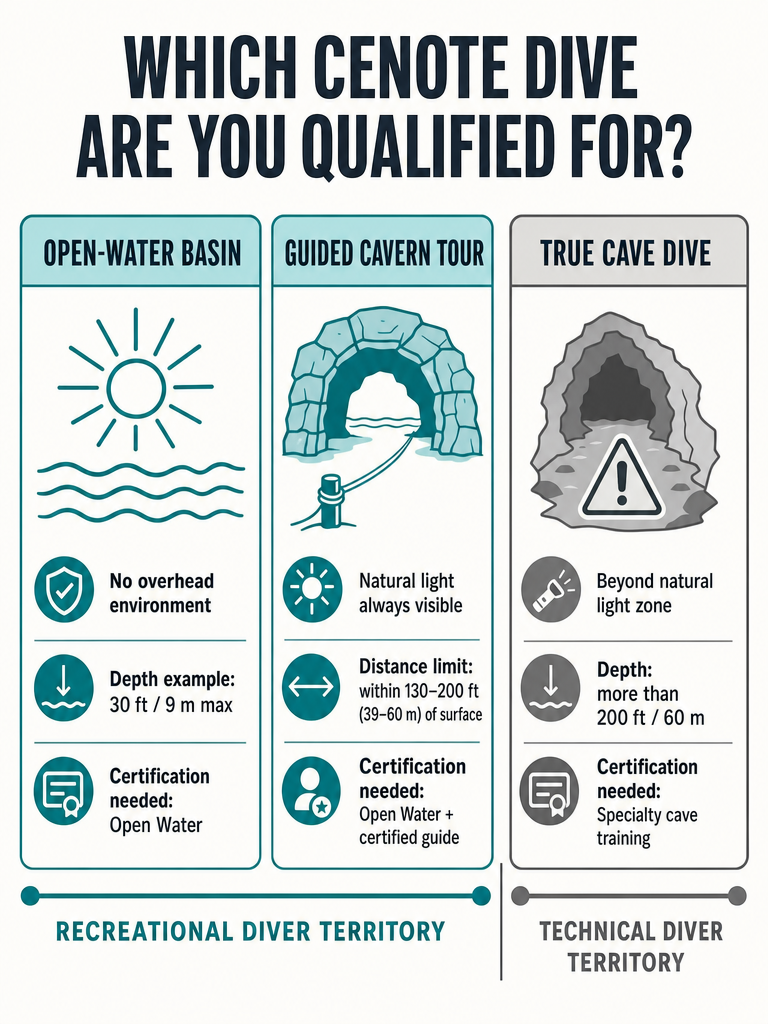
The honest answer to "can I dive cenotes" depends on which of three dive types you mean, because each carries a different overhead profile and a different training requirement. PADI splits cenote diving into open-water basins, guided cavern tours, and full cave dives, and your Open Water card covers only the first two when run correctly (Source: PADI).
Here's how the three break down:
| Dive type | What it involves | Who can do it |
|---|---|---|
| Open-water cenote dive | Large open basin, little to no overhead; divers stay out of any cave entrance | Certified Open Water divers |
| Guided cavern tour | Controlled, line-led tour inside the natural light zone, within 130–200 ft (39–60 m) of the surface | Open Water divers with a qualified guide |
| Cave diving | Beyond the light zone, past 200 ft (60 m), or through narrow passages | Full Cave Diver certification only |
PADI is blunt about why this matters: divers who enter overhead environments without the required training and equipment have diving's highest accident fatality rate (Source: PADI). That single line is the reason the route, not the cenote's name, decides whether you belong there.
If you want the full breakdown of where recreational diving ends and technical begins, our guide to cavern versus cave diving for tourists walks through it in plain language.
Do I need a cave diving certification to dive in cenotes?
No, most vacation cenote dives don't require cave certification, because they're recreational cavern dives that stay inside the natural light zone. Blue Life states that when you book a cenote dive with a Riviera Maya operator, you're usually talking recreational cavern diving, which needs at least an Open Water certification rather than technical cave training (Source: Blue Life).
The line is drawn by where the dive goes. Xico Dive Center confirms a first cenote dive is normally a guided cavern dive that follows a planned route and stays where natural light is still visible, not a full cave dive.
You only need specialized certification once a dive crosses recreational cavern limits. PADI defines that threshold as entering more than 200 ft (60 m), going beyond the light zone, or passing through a narrow area where the route tightens (Source: PADI). For that environment you'd need credentials like the Full Cave Diver certification, the PADI Cavern Diver Specialty, or the TecRec Cave Diver Distinctive Specialty.
For a guided cenote tour on vacation, your Open Water card is the certification that matters.
Which cenotes are best for beginners?
Casa Cenote and Chikin Ha are two of the most reliable Open-Water-friendly cenotes, because both stay shallow and well-lit. PADI describes Casa Cenote, located 37 miles south of Playa del Carmen, as suited to Open Water divers, with a route that follows a winding river for roughly 250 yards (228 m) and a basin bottom never deeper than 30 ft (9 m) (Source: PADI).
Chikin Ha, 20 miles south of Playa del Carmen, works for the same reasons: PADI puts its maximum depth at 42 ft (12.8 m) with visibility of 150 ft (45 m) or greater (Source: PADI). Xico Dive Center also names Chac Mool, Dos Ojos, and Chikin-Ha as cenotes that are usually better for first-time cenote divers.
| Cenote | Max depth | Distance from Playa | Why it suits Open Water divers |
|---|---|---|---|
| Casa Cenote | 30 ft (9 m) | 37 miles south | Open river route, little overhead |
| Chikin Ha | 42 ft (12.8 m) | 20 miles south | Shallow, very high visibility, light effects |
| Dos Ojos / Chac Mool | n/a* | n/a* | Named beginner-friendly first dives (Source: Xico Dive Center) |
*Specific depth and distance figures for Dos Ojos and Chac Mool aren't given in the sources used here, so they're left out rather than estimated.
You'll see famous names like The Pit and Angelita on plenty of lists, but public depth detail for Open Water suitability is limited as of this writing, and both are commonly deep, advanced sites. Don't book either off a reputation alone. For a wider menu, see our roundup of the best cenotes for diving in the Riviera Maya or the local picks for Open Water divers near Tulum.
Are all cenotes the same?
No, cenotes vary widely in light, depth, tightness, sediment, and overhead profile, which is why no single rule fits all of them. Cenote Dive Tour explains that some cenotes are open and full of light while others are darker, with tighter spaces or fine sediment that demands better buoyancy control, and a few reach approximately 30-33 meters (100-110 feet) deep (Source: Cenote Dive Tour).
That variation is the whole point. Cenote Dive Tour's advice is to stop thinking in terms of "beginner" or "advanced" labels and instead choose the right cenote based on your experience, comfort, and the type of diving you want. Blue Life estimates there are roughly 10,000 cenotes in the Yucatan Peninsula alone, so the range is enormous.
A bright, shallow basin and a dark, silty cavern can both be called cenotes and still demand completely different skills. The work is matching the site to the diver, which is exactly what a local guide handles before you ever get wet.
What skills do you need before your first cenote dive?
Buoyancy control is the single most important skill for a first cenote dive, because cavern routes pass through overhead sections, fine sediment, and formations that took centuries to form. Blue Life stresses that good buoyancy matters in cenotes precisely because of those delicate features, and PADI recommends refining it through the PADI Peak Performance Buoyancy course before your first guided tour (Source: PADI).
Beyond buoyancy, the practical readiness list is short and concrete. Xico Dive Center says you should be comfortable with these before your first cenote dive:
- Buoyancy control — hover steadily without bumping the bottom or ceiling.
- Calm, slow breathing — the cenote environment feels quiet and unusual at first.
- Equalizing — clear your ears smoothly on descent.
- Mask clearing — handle a flood without stress.
- Air checks — monitor and signal your gas regularly.
- Following a guide — stay in position and respond to signals.
- Avoiding contact with formations — keep fins and hands off the rock.
None of these are exotic. They're the core Open Water skills, sharpened. If you're feeling shaky on any of them, our piece on building confidence before a dive covers simple ways to settle in.
Ready to map out a cenote day around your skill level? Start Planning Your Dive and tell Seth where you're staying.
Should a rusty Open Water diver do a cenote, refresher, or reef dive first?
If you're certified but haven't dived recently, a refresher or an easier reef dive first is the smart move before a cenote. Xico Dive Center advises exactly this: divers who are certified but rusty should do a refresher or an easier reef dive before a guided cavern dive, because the right cenote depends on your certification level, last dive date, and comfort.
The reasoning is practical. A cenote rewards steady buoyancy and calm breathing, and those fade fastest when you've been out of the water for a year or more. A warm-up reef dive lets you rebuild trim, monitor your air, and settle your nerves in open water before you add an overhead route.
The Riviera Maya makes this easy. Playa del Carmen and Cozumel offer accessible reef diving that works well as a warm-up day, and choosing between them is straightforward once you know your goals. Our comparisons of cenote versus ocean diving and Cozumel versus Playa del Carmen reefs help you slot a refresher into the trip.
What safety controls should your cenote guide use before and during the dive?
A good cenote guide reduces risk by matching you to the right route, briefing you thoroughly, and keeping the group small and controlled. Cenote Dive Tour describes the standard: before entering the water, your guide gives a clear, practical briefing on cavern navigation, air management, and communication signals, then leads the dive along the cavern line (Source: Cenote Dive Tour).
Here's what a properly run first cenote day looks like:
- Route matching — the guide picks a cenote within your training and comfort, not the most dramatic one on offer.
- Cavern-line procedure — you follow a guided line that keeps the group on a planned path with a known exit.
- Natural-light limit — the dive stays where daylight is still visible, inside cavern limits.
- Air-management briefing — you agree on turn pressures and check intervals before descending.
- Communication signals — hand signals and positioning are set on the surface.
- Group control — Blue Life states local cenote rules limit groups to a 4 divers to 1 guide ratio (Source: Blue Life).
That 4:1 ratio is one reason crowded "cattle-boat" operations don't translate well to cenotes. Small groups are the safety standard here, not an upsell. Seth Dive Mexico runs private and semi-private cenote dives that keep ratios low and briefings unhurried, which is the entire point of diving an overhead environment with people you trust.
What if someone in your group is not certified?
Non-certified travelers can't join a recreational cavern dive, but they're not shut out of cenotes entirely. Xico Dive Center is direct: cenote scuba diving is for certified divers, it is not a Discover Scuba activity, and it is not for non-certified guests. Cenote Dive Tour echoes that cavern diving requires at least an Open Water certification.
That said, options exist for the uncertified members of your group. Cenote Dive Tour notes that Discovery Scuba Diving is available only in shallow open cenotes, never in the cavern zone. Snorkeling is the other route, and cenote snorkeling lets non-divers float through the same clear, light-filled water above the surface.
A common mixed-group plan is simple: certified divers do a guided cavern dive while non-certified companions snorkel the same cenote. Our cenote snorkeling packing list and the guide to choosing a first scuba experience help everyone in the group find their fit.
How should you choose a cenote operator if you are Open Water certified?
Choose a cenote operator that screens your certification, matches you to a route within your limits, and keeps groups small. The sources agree on the principle: PADI ties access to staying inside cavern limits, and Cenote Dive Tour ties safety to guides who lead Open Water divers personally along the cavern line. The operator's job is to enforce those limits, not stretch them.
Use this checklist before you book:
| What to verify | Why it matters |
|---|---|
| Certification screening | A serious operator asks for your card and last dive date (Source: Xico Dive Center) |
| Site matching | The cenote should fit your training, not just the operator's schedule |
| Guide qualifications | Cavern tours require a guide qualified to lead them along the line (Source: PADI) |
| Small groups | Local rules cap groups at 4 divers per guide (Source: Blue Life) |
| Gear and exposure protection | A 5 mm wetsuit suits the ~24°C/77°F water (Source: Blue Life) |
| Transport and logistics | Clear pickup and itinerary handling protect your vacation time |
That last point is where booking friction usually lives. Seth Dive Mexico offers free hotel pickup across the Riviera Maya, from Cancun to Tulum, and handles gear and itinerary planning so you're not stitching together a dive day from scratch. To weigh the formats, compare private versus group dive tours and check what shapes private cenote diving cost.
Message Seth with your dates, hotel, and certification level, and you'll get a route recommendation built around your comfort instead of a crowded boat manifest.
Frequently asked questions
Can you dive cenotes with an Open Water certification in Mexico?
Yes — an Open Water certification is enough for guided cavern tours in Mexico's cenotes, provided the dive stays within the natural light zone and within 130 to 200 ft (39–60 m) of the surface. PADI confirms this is a "highly controlled, limited tour along a line" — not a full cave dive. Your card covers the right routes; it doesn't cover every route at every cenote.
Do you need a cave diving certification to dive cenotes in the Riviera Maya?
No. Most vacation cenote dives are recreational cavern dives that only require an Open Water certification. Cave certification becomes mandatory when a dive crosses 200 ft (60 m) from the entrance, leaves the natural light zone, or passes through a passage too narrow for easy exit — thresholds defined by PADI. For a guided day trip near Playa del Carmen or Tulum, your Open Water card is what matters.
Which cenotes are best for Open Water divers near Playa del Carmen?
Casa Cenote and Chikin Ha are two of the most reliable starting points. PADI puts Casa Cenote's maximum depth at 30 ft (9 m) along a 250-yard river route — minimal overhead, easy navigation. Chikin Ha tops out at 42 ft (12.8 m) with visibility of 150 ft (45 m) or greater. Chac Mool and Dos Ojos are also commonly recommended for first-time cenote divers. Confirm site suitability with your guide before booking.
What skills do you need before your first cenote dive?
Buoyancy control is the most critical skill — cavern routes pass through overhead sections and delicate formations that took centuries to form. Beyond that, you need comfortable equalizing, calm breathing, mask clearing, routine air checks, and the ability to follow a guide's signals without hesitation. PADI recommends the Peak Performance Buoyancy course to sharpen these before your first guided cenote tour.
Can non-certified travelers experience cenotes in Mexico?
Non-certified guests can't join a recreational cavern dive, but two options stay open: Discovery Scuba Diving in shallow, open cenote basins (no certification required), and cenote snorkeling above the surface of the same crystal-clear water certified divers explore below. A common group plan pairs a guided cavern dive for certified divers with snorkeling for non-certified companions at the same site.
Should a rusty certified diver do a refresher before a cenote dive?
Yes — a warm-up reef dive or a full refresher first is the practical move if you haven't been in the water recently. Cenote diving rewards steady buoyancy and calm air management, both of which fade during a long surface interval. Playa del Carmen and Cozumel both offer accessible reef diving that rebuilds your trim before you add an overhead environment to the equation.
Sources
- Must-Dive Cenotes for Open Water Divers - PADI Blogblog.padi.com
- Cenote Diving - FAQ • Blue Life • Playa del Carmencenotedivetour.com