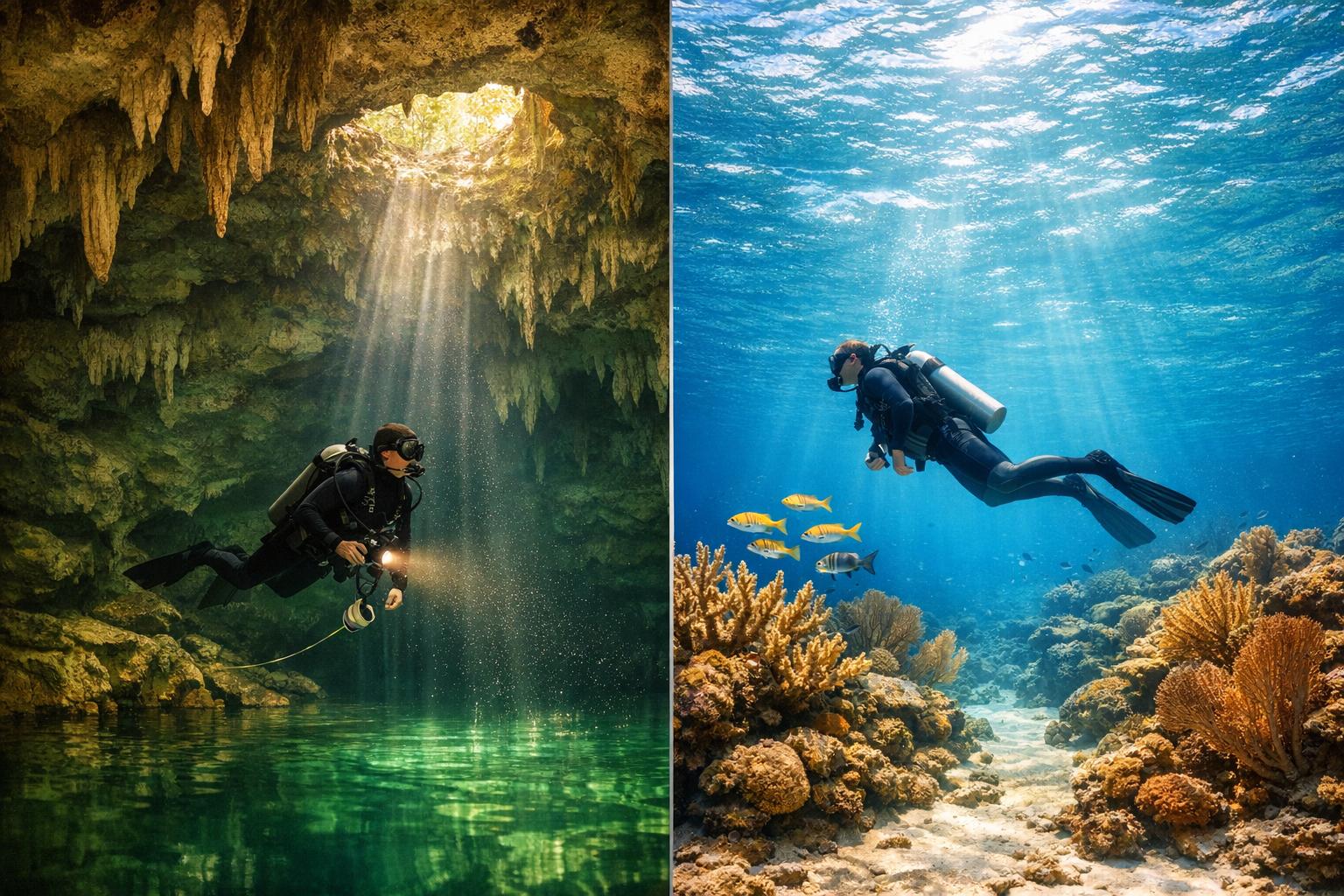
Cenote diving and ocean diving in the Riviera Maya offer two very different underwater experiences. Cenote diving takes you into calm, crystal-clear freshwater sinkholes with stunning rock formations and unique lighting effects. Ocean diving, on the other hand, immerses you in the vibrant saltwater of the Caribbean, full of marine life like coral reefs, sea turtles, and rays.
Here’s a quick breakdown:
- Cenote Diving: Freshwater, no currents, visibility up to 30 meters, steady 24°C water, and unique formations like stalactites and haloclines. Requires precise buoyancy control.
- Ocean Diving: Saltwater, varying visibility (8–36 meters), warmer water (26–28°C), and abundant marine life like fish, sharks, and turtles. Conditions depend on weather and tides.
Both offer unforgettable experiences, but your choice depends on whether you prefer the serene, enclosed beauty of cenotes or the lively, open waters of the ocean.
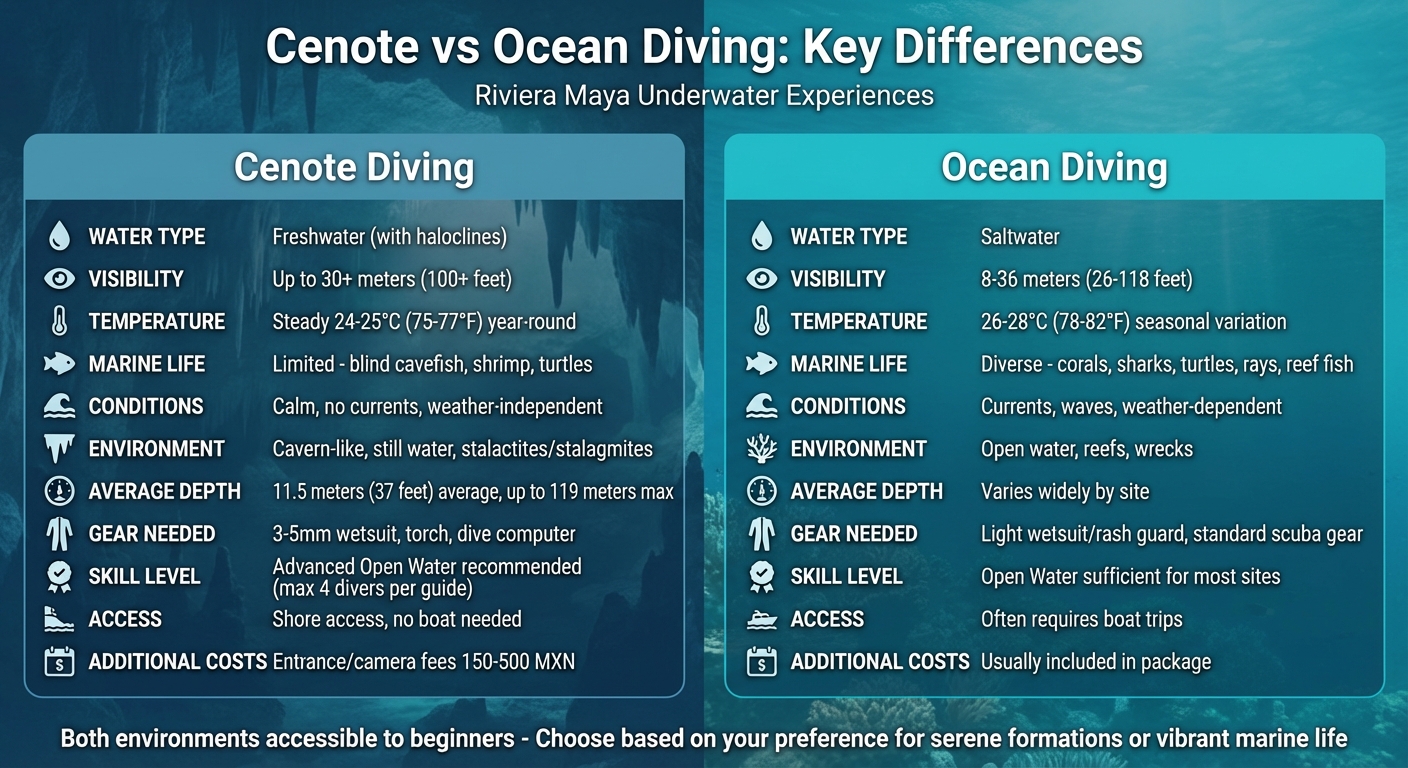
Cenote vs Ocean Diving: Complete Comparison Guide
Beginner DIVE GUIDE for TULUM Mexico 🇲🇽 Cenote, ocean and cave diving for your scuba dive license
sbb-itb-8d6faf7
Quick Comparison
| Attribute | Cenote Diving | Ocean Diving |
|---|---|---|
| Water Type | Freshwater | Saltwater |
| Visibility | Up to 30 meters | 8–36 meters |
| Temperature | 24°C (steady year-round) | 26–28°C (seasonal variation) |
| Marine Life | Limited (blind cavefish, turtles) | Diverse (corals, turtles, sharks) |
| Conditions | Calm, no currents | Currents, waves, weather-dependent |
| Depth | 11.5 meters average, up to 119 meters | Varies widely by site |
| Gear | 3–5 mm wetsuit, torch | Light wetsuit, standard scuba gear |
| Skill Level | Advanced Open Water recommended | Open Water sufficient for most sites |
Whether you’re drawn to the tranquil atmosphere of cenotes or the dynamic energy of ocean diving, the Riviera Maya lets you enjoy both worlds in one destination.
Water Environment and Visibility
Freshwater vs. Saltwater
Cenotes, with their freshwater systems carved through limestone, offer a completely different diving experience compared to the Caribbean's saltwater environment. This difference impacts everything from buoyancy to how you maintain your gear. In freshwater, you’ll need less weight to stay neutrally buoyant because it’s less dense than saltwater. On the other hand, the ocean’s denser, saltier water makes you float more, so adjustments to your weight belt are necessary [6].
Another perk of diving in freshwater is that your gear tends to last longer. Without the salty residue left by ocean dives, your equipment requires less intensive maintenance [1]. Some cenotes also feature a fascinating phenomenon called a halocline - a distinct layer where freshwater and saltwater meet. This is often found around 12 meters deep in spots like The Pit [2]. Cave diver and author Natalie Gibb describes it vividly:
Floating above the halocline resembles swimming over an underwater river with gentle ripples [5].
Cenote Tours adds:
Diving near the halocline creates a jelly-like visual effect [6].
These unique water properties not only shape the diving experience but also influence what you see and how clearly you see it underwater.
Visibility and Water Conditions
The water conditions in cenotes are famous for their clarity, offering visibility of up to 30 meters (100 feet). This crystal-clear view is thanks to the natural filtration provided by limestone and the absence of waves, currents, or tides. Despite the excellent visibility, carrying a torch is still crucial to light up shadowed areas and reveal the stunning formations in cavern zones [2][5].
Ocean visibility in the Riviera Maya, however, can vary greatly depending on factors like weather, plankton levels, and the season. The dry season, running from November to April, usually provides the most consistent underwater clarity [2][7]. But summer rains can affect visibility, especially in shallow areas. In some cenotes, rainfall triggers the decomposition of organic matter in open sites like Carwash or Casa Cenote. This process creates a layer of tannin-rich water - often yellow, orange, or green - that floats above the clear freshwater, forming a distinct, meter-thick layer [7]. Scuba instructor Cyril M explains:
Visibility can be temporarily reduced due to sediments or tannins brought in by the rain, especially near the entrances or at the surface [7].
Marine Life and Ecosystems
Ocean Biodiversity
The Riviera Maya, nestled within the Mesoamerican Barrier Reef system, is home to an incredible variety of marine species. Among its most iconic inhabitants are sea turtles - green, hawksbill, and loggerhead - that glide gracefully through the clear Caribbean waters year-round. As diving instructor Cyril M explains:
"The Riviera Maya is one of the best places in Mexico to see sea turtles while diving... They're present year round." [9]
But turtles are just the beginning. Divers exploring the vibrant coral gardens and swaying sea fans often encounter spotted eagle rays, stingrays, moray eels, and even barracudas weaving through the underwater scenery [8]. The region's seasons bring additional wonders: whale sharks frequent the waters from June to September, while bull sharks gather near Playa del Carmen between November and March [8][9]. Over in Cozumel, the elusive splendid toadfish - found nowhere else in the world - might make an appearance for lucky divers [9].
In contrast to the open ocean, the Riviera Maya's cenotes offer an entirely different kind of underwater experience.
Cenote Ecosystems
Cenotes, or natural sinkholes, create an otherworldly freshwater environment where life has adapted to near-darkness. Diving in these unique systems reveals species perfectly suited to their dim surroundings. Among the fascinating creatures are the Mexican blind tetra (Astyanax mexicanus), blind cave fish, pale catfish, and the Yucatán blind eel [11]. Scuba Schools International (SSI) notes:
"Each cenote has its own unique ecosystem but blind brotula and pale catfish are consistent cast members at each cenote." [3]
Some cenotes, such as Casa Cenote, even host Mexican crocodiles, blue crabs, and Meso-American slider turtles [3][10]. Instead of coral, these environments feature striking visuals like submerged tree roots, mangroves, and water lilies [3][10]. Haloclines - where saltwater and freshwater meet - create mesmerizing visual effects, while hydrogen sulfide clouds and ancient fossils add to the surreal atmosphere [2][10]. In open cenotes, wildlife extends above the waterline, with motmot birds nesting in the walls and cormorants diving to catch fish [10].
Whether exploring the vibrant reefs or the shadowy cenotes, the Riviera Maya offers a breathtaking glimpse into the diversity of aquatic life.
Temperature and Comfort
Temperature Stability
Diving in the Caribbean offers consistently pleasant water temperatures. During summer, ocean temperatures hover between 27–29°C (80–84°F), cooling slightly in winter but staying comfortable all year. Cenotes, on the other hand, maintain a steady 24°C (75°F) throughout the year due to their underground aquifer source. Scuba instructor Cyril M highlights this consistency:
The water stays at a constant temperature of around 24°C or 75°F, providing comfortable diving conditions throughout the seasons[7].
However, this stability can feel cooler compared to ocean dives. As instructor divingjd points out:
Ocean temperatures are usually 79–81. Cenotes typically measure 75°F, noticeably cooler than ocean temperatures[12].
For longer dives, the difference becomes more noticeable, especially in deeper cenotes where temperatures can drop to 23°C (73°F)[12]. This variation in temperature means divers need to adjust their gear accordingly.
Wetsuit and Gear Considerations
The temperature differences between ocean and cenote diving call for specific thermal protection. In freshwater cenotes, you'll need less weight on your belt since freshwater is less buoyant than saltwater[12]. For Caribbean ocean dives, a 3mm wetsuit is sufficient. However, cenote dives, which usually last 45–60 minutes, require a 5mm wetsuit for added warmth[12].
Post-dive comfort is also important. Packing warm clothes or a dry towel can make all the difference after a chilly cenote dive[2]. Interestingly, many divers save cenote dives for the end of their trip, as the freshwater provides a natural "rinse" for gear exposed to ocean salt[12].
Safety Requirements and Skill Levels
Both cenote and ocean diving can be safe as long as you stick to the right protocols and have the necessary skills. Knowing the differences between these two types of dives helps you pick the ones that suit your experience and ensures you're ready for the challenges ahead.
Cenote Diving Skills
Cenote diving demands precise buoyancy control and slow, deliberate movements. Unlike ocean diving, you can't just ascend to the surface if something goes wrong - there's a rock ceiling above you. This overhead environment means you must always follow a continuous guideline to return to the entrance safely. As Tom St George explains:
While a recreational cavern tour is very different from a cave dive, it borrows heavily from protocols used for cave diving. The most important being that there should always be a continuous guideline that you can follow to reach open water safely [4].
Gas management in cenote diving follows the "Rule of Thirds": one-third for entry, one-third for exit, and one-third as a reserve [4][13]. This is stricter than the ocean diving approach, which often uses the half-tank rule. You'll also need to master the frog kick to avoid stirring up silt, which can quickly reduce visibility [13]. Most cenote dives require at least an Advanced Open Water certification, and the number of divers is limited to a maximum of four per qualified guide [4]. To avoid potential issues, remove your snorkel before starting the dive to prevent entanglement [13], and keep your dive lights on at all times to aid communication and orientation [4].
Ocean diving, on the other hand, comes with its own set of challenges.
Ocean Diving Skills
Ocean diving introduces variables like strong currents, waves, and surges, which call for solid swimming and navigation abilities. The advantage here? If needed, you can ascend directly to the surface. However, ocean conditions can shift with the weather and tides, so you'll need to learn how to interpret the water and adjust your dive plan accordingly. For most Caribbean reef dives, an Open Water certification is sufficient.
Instead of relying on a continuous guideline like in cenote diving, you'll use tools such as compass navigation and natural landmarks to find your way. Additionally, the ocean environment requires you to practice proper ascent rates and safety stops, even in moving water - skills that aren't typically needed in the still, calm cenote conditions.
Each environment has its own set of demands, but with the right preparation, both can offer incredible diving experiences.
Sensory Experience and Atmosphere
The emotional pull of cenote and ocean diving couldn't be more different. These environments set the tone for your underwater journey - cenotes bring a sense of calm and introspection, while the ocean feels expansive and full of energy. Let’s dive deeper into how these surroundings shape what you see, hear, and feel beneath the surface.
Cenote Atmosphere
Cenote diving feels like stepping into a tranquil sanctuary. There's a stillness that lets you focus on your own breath and heartbeat. As EWDR describes:
It is quiet, serene, and smells slightly mineral – a very different feeling than in the sea.[2]
Visually, the experience is mesmerizing. Sunlight streams through the water, bouncing off rocky walls and turning bubbles into glowing spheres. In semi-open cenotes, the dance of light and shadow creates stunning visual effects. Deeper cenotes like Angelita or The Pit offer something entirely surreal - clouds of hydrogen sulfide form a ghostly underwater fog, with tree branches eerily poking through the haze.[2][14] Swimming through these tight spaces, surrounded by stalactites and stalagmites, feels otherworldly. Bluewater Dive Travel beautifully captures this experience:
Entering the water through tree roots and fallen branches feels like the beginning of a fairytale, guiding you into a strange world.[14]
This enclosed, almost dreamlike environment is a stark contrast to the vast openness of ocean diving.
Ocean Atmosphere
Ocean diving in the Riviera Maya flips the script entirely. Instead of the quiet introspection of cenotes, the ocean buzzes with life and energy. The soundscape, often called "reef chatter", is alive with the clicks, pops, and hums of marine life. The constant motion of currents, waves, and tides adds to the sensation of being part of a vast, interconnected world.
Visually, the ocean offers endless freedom. Above, the shimmering surface reflects sunlight; below, vibrant coral reefs stretch as far as the eye can see. Unlike the enclosed walls of cenotes, the ocean invites exploration in every direction. Each dive brings the thrill of encountering marine creatures like fish, turtles, and other wildlife in their natural habitat. It’s an experience that feels wide open and full of discovery.
Comparison Table: Cenote vs Ocean Diving
Key Attributes
Here's a breakdown of the main distinctions between cenote and ocean diving in the Riviera Maya. This table highlights the unique aspects and what divers need to consider for each.
| Attribute | Cenote Diving | Ocean Diving |
|---|---|---|
| Water Type | Freshwater (sometimes with haloclines) | Saltwater |
| Visibility | Exceptionally clear: 30+ metres (100+ feet) | Varies: 8–36 metres (26–118 feet), depending on season and conditions [15] |
| Temperature | Steady: 24°C–25°C (75°F–77°F) all year | Fluctuates: 26°C–28°C (78°F–82°F) in tropical seasons |
| Marine Life | Limited: blind cavefish, shrimp, turtles | Diverse: corals, sharks, turtles, rays, reef fish |
| Environment | Cavern-like with calm, still water | Open water with currents, tides, and waves |
| Topography | Features stalactites, stalagmites, caves, fossils, haloclines | Includes reefs, wrecks, and sandy bottoms |
| Primary Gear | 3–5 mm wetsuit, underwater torch, dive computer | Light rash guard or thin wetsuit with standard scuba gear |
| Training Required | Open Water (for guided cavern dives) to Full Cave certification | Open Water to Advanced/Wreck specialties |
| Conditions | Calm, no currents; weather-independent [15][2] | Influenced by wind, waves, plankton, and surface conditions |
| Average Depth | 11.5 metres (37 feet); some sites go as deep as 119 metres (391 feet) [3] | Depths range significantly by site |
| Logistics | Shore access; no boat needed [3] | Often requires boat trips to reach dive locations |
| Guide Ratio | Maximum of 4 divers per guide (regulated by Mexican law) [15] | Varies by operator and certification level |
| Additional Fees | Entrance and camera fees: 150–500 MXN [2][14] | Usually included in dive package costs |
Cenote diving offers a serene, almost otherworldly experience with its underground formations, requiring precise buoyancy control to protect these ancient structures. On the other hand, ocean diving delivers a lively, ever-changing environment teeming with marine life, where divers must stay alert to shifting conditions. Whether you’re drawn to the calm mystery of cenotes or the vibrant energy of the open sea, each experience has its own charm.
Conclusion: Choosing the Right Diving Experience
Deciding between cenote and ocean diving comes down to what captivates you most about the underwater world. If you're fascinated by stunning rock formations and the echoes of Mayan history, cenote diving offers a tranquil escape. With crystal-clear freshwater and visibility often exceeding 30 meters, you'll immerse yourself in a world shaped by stalactites, stalagmites, and ancient mysteries.
On the flip side, if vibrant marine life and ever-changing conditions excite you, ocean diving is the way to go. Coral reefs teeming with tropical fish, encounters with sea turtles and rays, and the thrill of open water currents make every dive an adventure filled with surprises.
Cenote diving is convenient, with easy shore access and minimal weather dependency. You’ll typically need a 5 mm wetsuit, and some cenotes charge a small camera fee (150–500 MXN) [2]. Ocean diving, however, often involves boat trips and relies on favorable sea conditions, though the slightly warmer water allows for lighter gear, like thinner wetsuits or rash guards. These logistical details highlight the unique nature of each experience.
Both environments are accessible to beginners with an Open Water certification. Cenote diving emphasizes precise buoyancy control to avoid disturbing sediment, while ocean diving requires attention to currents and surface conditions. For advanced divers, cenotes offer deeper, more technical dives or even full cave certifications, while the ocean presents opportunities for wreck and drift dives.
The Riviera Maya provides a rare chance to enjoy both worlds. Alternating between the serene cenotes and the lively Caribbean waters creates a well-rounded diving experience. Each environment challenges you in different ways and rewards you with unforgettable memories, making it hard to choose just one. Why not explore both?
FAQs
Can I do a cenote dive with only Open Water certification?
Yes, with an Open Water certification, you can explore many cenotes, especially those with open water sections. However, cenotes that include overhead environments or intricate cave systems typically demand advanced certifications to ensure your safety.
What should I pack for cenote vs ocean diving in Riviera Maya?
When preparing for cenote diving, it’s essential to pack for the unique challenges of these freshwater sinkholes. Make sure to include:
- A wetsuit to stay comfortable in the cooler freshwater temperatures.
- A mask and fins, as some cenotes have tighter spaces requiring precise movements.
- Extra lighting, such as dive torches, since cenotes can be quite dark.
- Safety gear like spare equipment or long hoses for added security.
- Your certification documents, as guided dives often require proof of your diving qualifications.
For ocean diving, the gear list shifts slightly to suit the warmer, saltwater environment. Be sure to bring:
- A wetsuit appropriate for the warmer waters.
- Standard diving equipment, including a mask, fins, and a buoyancy control device (BCD).
- Reef-safe sunscreen to protect marine life while shielding your skin.
- A dive computer to monitor your depth and time underwater.
Additionally, always check with your dive operator for any specific gear or requirements they might have for your dive.
Which is better for photos: cenotes or the ocean?
Cenotes are often a photographer's dream, thanks to their crystal-clear freshwater, breathtaking natural light effects, and distinctive geological formations. These elements come together to create the perfect setting for capturing stunning underwater shots.
Frequently Asked Questions
Do I need Advanced Open Water to go cenote diving, or is Open Water enough?
Open Water certification is enough for guided cavern dives in many cenotes, where you stay near the entrance with natural light visible. Sites with deeper overhead environments or more complex passages typically require Advanced Open Water, so the right cenote for you depends on your current certification level — share it with your guide when booking and they can match you to the best site.
Can complete beginners try cenote diving without any scuba certification?
Yes — a Discover Scuba experience lets non-certified beginners enter certain cenotes under direct one-on-one supervision, no prior training needed. Cenote snorkeling is another excellent entry point that requires no scuba certification at all and still delivers stunning views of the formations and light effects.
Which should I book first on a Riviera Maya trip — cenote diving or ocean diving?
Many experienced divers save cenote dives for later in the trip, since the freshwater naturally rinses salt and residue from gear after ocean dives. That said, cenotes are weather-independent and calm year-round, so they make a smart backup on days when ocean conditions are rough.
How do I get to the cenotes from Cancun, Playa del Carmen, or Tulum?
The main cenote dive sites are scattered along the Tulum corridor, roughly 45–90 minutes from Cancun and 20–40 minutes from Playa del Carmen. Seth Dive Mexico includes free hotel pickup from anywhere between Cancun and Tulum, so you don't need to rent a car or sort out directions on your own.
Is cenote diving safe if I'm not comfortable in enclosed or dark spaces?
Cavern-style cenote dives stay within the daylight zone, meaning you can always see natural light and the open entrance — this is very different from a full cave dive. A small-group guide who keeps the ratio to four divers or fewer can pace the dive around your comfort level and help you stay relaxed throughout.