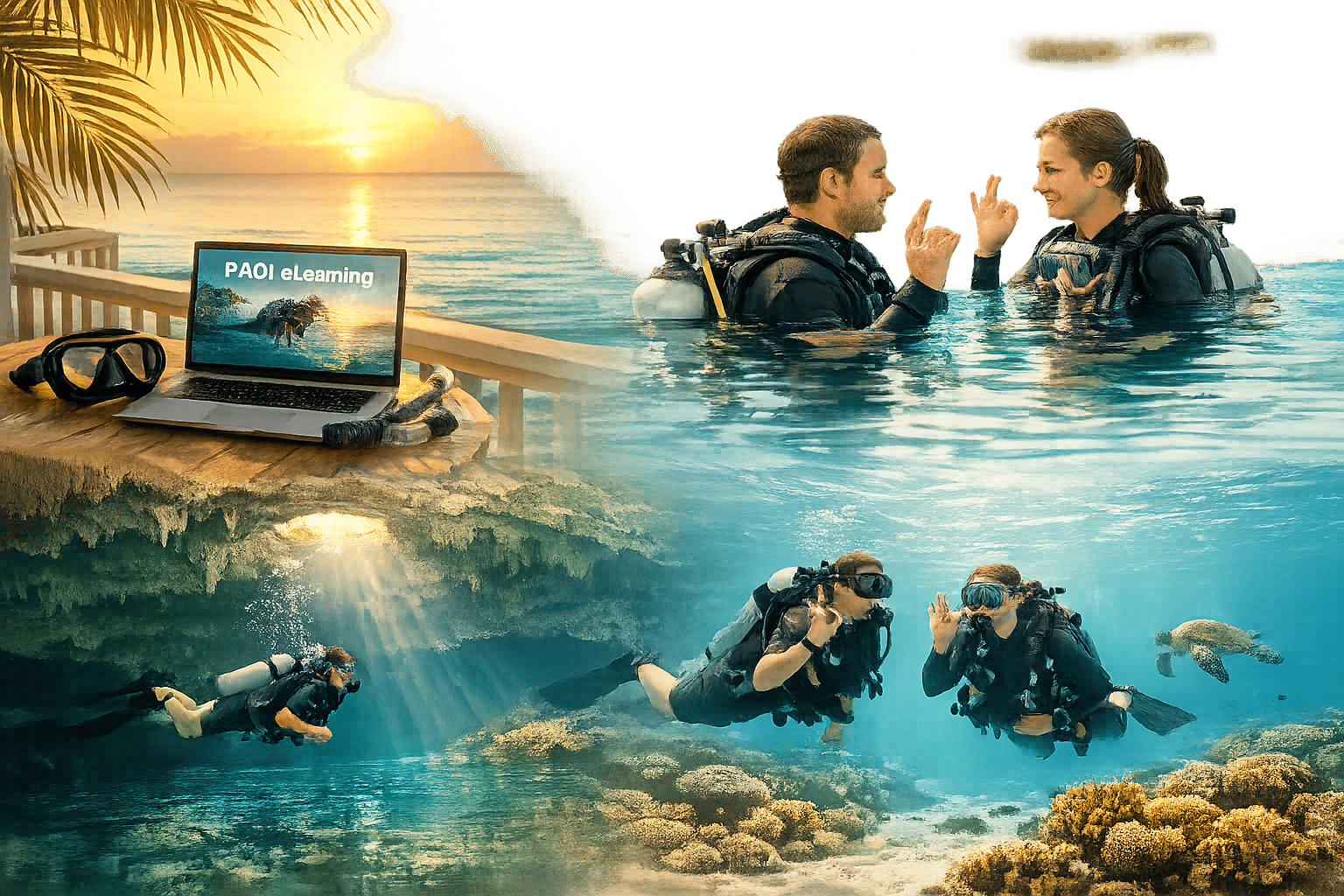
Earn your PADI Open Water certification in just 3–4 days while enjoying the stunning Riviera Maya. Here's how it works:
- Complete Online Theory Before Traveling: Save time by finishing the PADI eLearning theory at home for $251 USD. Study at your own pace and bring your eRecord to Mexico.
- In-Water Training: Spend 3–4 days mastering skills in pools, cenotes, and the Caribbean Sea. Courses include 5 confined water sessions and 4 open-water dives.
- Flexible Options: Choose between full certification in Mexico or start at home with a referral program. Prices range from $325–$400 USD, covering gear, transportation, and dive site access.
- Explore Unique Dive Sites: Train in cenotes with crystal-clear water and explore vibrant reefs filled with marine life.
Seth Dive Mexico offers private, multilingual instruction tailored to your schedule, making it easy to balance diving with vacation activities. Plan dives early in your trip and allow 18–24 hours before flying. Dive into the adventure and leave with a globally recognized certification.
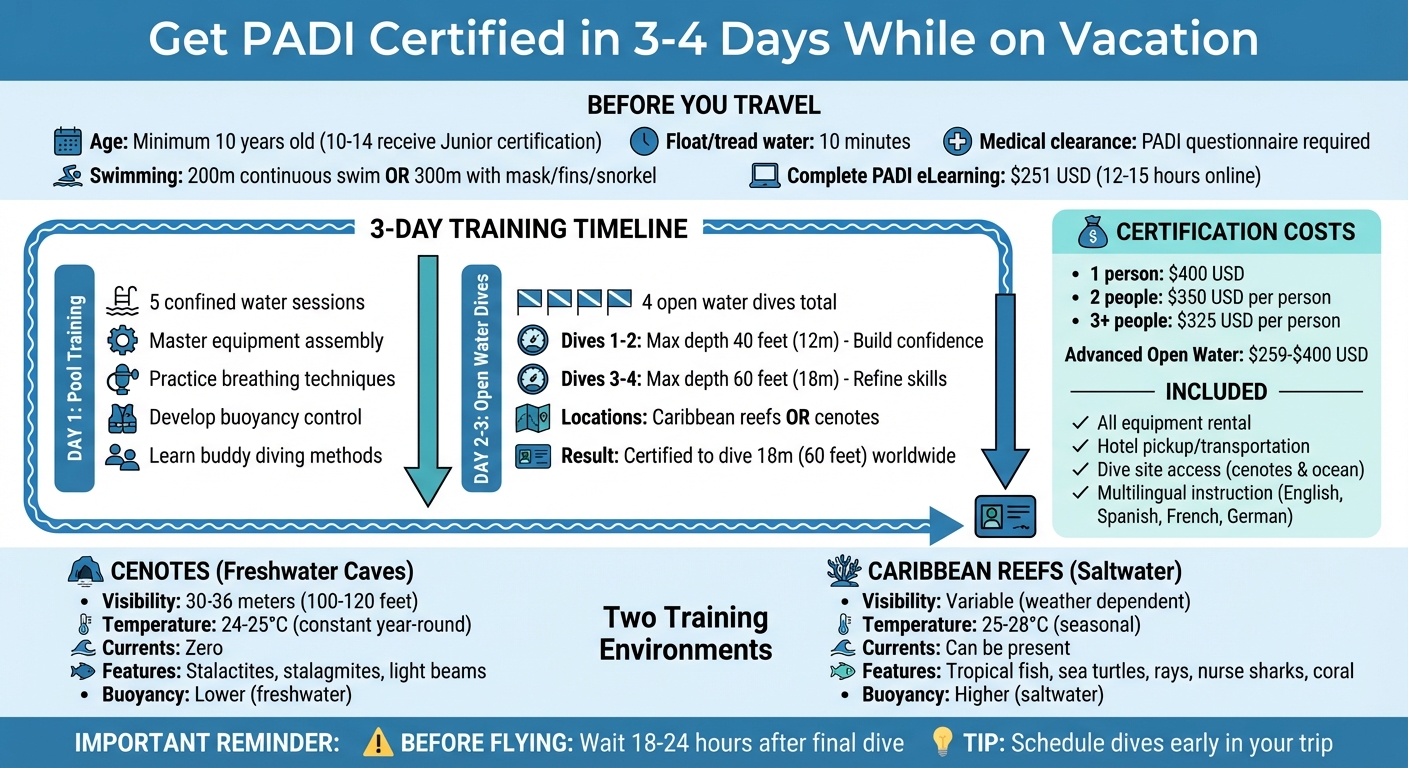
PADI Open Water Certification Process: 3-Day Timeline and Requirements
PADI Certification Requirements
Age, Swimming, and Medical Requirements
To begin your journey toward PADI certification, you’ll need to meet a few basic requirements. First, you must be at least 10 years old to enroll in the PADI Open Water Diver course [6]. If you're between the ages of 10 and 14, you’ll receive a Junior Open Water Diver certification, which automatically upgrades to the standard Open Water Diver certification when you turn 15 [6]. For those under 13, a parent or guardian must grant permission to register for PADI eLearning [6]. These guidelines ensure a safe and effective learning experience, especially in areas like the Riviera Maya.
Swimming skills are also essential, but you don’t need to be a pro. You’ll need to complete a 200-meter continuous swim using any stroke, with no time limit. Alternatively, you can swim 300 meters using a mask, fins, and snorkel. On top of that, you’ll need to float or tread water for 10 minutes [6].
"To be certified as a PADI Open Water Diver, you need to be at least 10 years old, fit for diving, and able to swim." - PADI [5]
A medical clearance is required for all participants. Before starting any in-water training, you’ll need to fill out a PADI medical questionnaire [6]. This form covers conditions related to your heart, lungs, ears, sinuses, or anything that could affect your consciousness. If you answer "yes" to any question, a doctor’s approval is necessary to confirm you’re fit to dive [6]. It’s a good idea to download and review the form before your trip to avoid any delays, especially if a doctor’s visit is needed.
For individuals with physical challenges, such as paraplegia or amputations, adaptive techniques can help meet the course’s performance requirements [6]. However, diving is not recommended for pregnant women or those trying to conceive, as the potential effects on the fetus remain unclear [6].
sbb-itb-8d6faf7
Scuba Diving For The FIRST TIME! PADI Open Water Course! (Cancun, Mexico)
Why Choose Seth Dive Mexico for Your Certification
Seth Dive Mexico provides private, tailored instruction designed to match your pace and schedule. Whether you’re a beginner or looking to advance your skills, lessons are available in four languages - English, Spanish, French, and German. The flexible scheduling means you can easily fit diving into your vacation plans. Want to explore the Tulum ruins in the morning and dive in the afternoon? No problem. Prefer to coordinate your certification with day trips to Playa del Carmen or Cozumel? That works too.
What makes training here stand out is the variety of environments. You’ll practice in both ocean reefs and cenotes - those stunning freshwater caverns unique to the region. This approach teaches you to handle different conditions from the start, unlike traditional pool-based training.
"See what many believe to be the most beautiful sights in the world as you fly through the caverns of the Mayan underworld." - Seth Dive Mexico
Courses start at $99 USD, with full Open Water certification costing $325–$400 USD, depending on group size. The price includes everything you need - equipment, hotel pickup, and access to cenote and ocean dive sites. No hidden fees. Ready to dive in? Check out the course options below.
PADI Open Water and Advanced Courses Available
Seth Dive Mexico offers PADI-certified courses that cater to different experience levels. The Open Water Diver course takes three days, qualifying you to dive independently up to 18 metres. Training combines pool sessions with four open water dives, held in either cenotes or Caribbean reefs - your choice.
Already certified? The Advanced Open Water Diver course is perfect for leveling up. Priced between $259 and $400 USD, it includes five adventure dives focusing on specialties like deep diving, navigation, and even night diving. It’s ideal for travelers looking to add excitement and new skills to their vacation.
Both courses include all materials, equipment, and hotel transportation, following PADI’s global standards. Plus, the Riviera Maya’s breathtaking underwater scenery makes for an unforgettable classroom. With prices and schedules designed to fit travel plans, you can earn your certification without missing out on other vacation activities.
Benefits of Private and Personalized Training
Private instruction means all the attention is on you. Your instructor will take the time to ensure you’re confident with essential skills, such as buoyancy control and equalizing, before moving forward.
This personalized setup also allows for flexibility. Prefer a late start after a fun night in Playa del Carmen? Or need to finish early to catch a Tulum sunset? Your schedule can be adjusted to fit your plans.
One-on-one training is especially valuable in cenote environments, where navigating caverns requires extra care. This focused approach not only boosts safety but also ensures a relaxed and enjoyable learning experience, making the most of your vacation time.
Complete Online Theory Before Your Trip
Completing your PADI eLearning before arriving in Mexico can save you precious vacation time. By handling the theory portion online, you can skip the classroom entirely and dive straight into the fun. The online course covers all the essentials, like dive principles, safety protocols, and equipment basics. Through interactive presentations, videos, graphics, and quizzes, you can study at your own pace [5].
"By completing your theory from home in advance, you won't have to spend hours in a classroom when you're on your vacation. You'll simply take a quick review... and the rest of your holiday time will be packed with the fun stuff – being underwater!" - Sarah Wormald, PADI Blog Author [12]
The PADI Open Water Diver eLearning costs $251.00 USD and takes about 12–15 hours to complete. Once finished, you'll receive a digital eRecord that's valid at any dive center, including Seth Dive Mexico. This eRecord is good for up to a year, so you can plan your trip without stress. Just print the document or email it to your instructor before your first session [5][8][9].
For added convenience, download the PADI Training app to study offline during your flight or other travel time [10][11]. The app lets you access course materials without an internet connection, perfect for long travel days. When you're ready to submit quizzes or Knowledge Reviews, reconnect to sync your progress [9]. Once you're set, accessing your eLearning materials is a breeze.
How to Access PADI eLearning Materials
After completing your theory, accessing your eLearning portal is quick and easy. Start by registering on the PADI eLearning portal using a compatible browser like Chrome, Safari, or Firefox [9]. During registration, you'll choose a dive center, but don't worry - you can still complete your in-water training with Seth Dive Mexico even if you initially select a different shop [9]. Your login will be tied to your registration email [9].
Once you've paid, you'll immediately gain access to the course. Work through the five Knowledge Reviews and quizzes to test your understanding of key safety topics [5][11]. When you're done, log back into the portal, select your course, and click "View your Performance & eRecord" to download your eRecord [9]. Bring this document to your first session in Mexico, where you'll complete a quick in-person review before diving into the water [5][11].
The 3-Day In-Water Training Schedule
Once you've completed the online theory portion, your diving adventure begins in the breathtaking waters of the Riviera Maya. Seth Dive Mexico offers a 3–4 day PADI Open Water course, blending hands-on training with the natural beauty of the area’s reefs and cenotes[2]. This schedule is designed to build your confidence step-by-step, starting in a controlled environment before moving into open water. The goal? To maximize your time underwater during your vacation instead of spending it in a classroom[2].
The program includes 5 confined water sessions and 4 open water dives, all under the guidance of experienced instructors who focus on safety and personalized support[2]. Thanks to the region's calm waters and expert instruction, local dive centers boast high success rates for students earning their certification[14].
Day 1: Pool Training and Skills Practice
Your first day is all about getting comfortable with the basics in a controlled pool environment. During 5 confined water sessions, often condensed into one or two intensive training periods, you'll master essential skills like:
- Assembling and using your diving equipment
- Practicing breathing techniques
- Developing buoyancy control
- Learning buddy diving methods
- Handling common underwater challenges
Before advancing to open water, you'll need to demonstrate two key physical abilities: swimming 200 yards at your own pace and floating or treading water for 10 minutes[15]. By the end of the day, you'll feel confident with your gear and ready to take on open water dives. This solid foundation prepares you for the challenges ahead.
Day 2-3: Open Water Dives in Riviera Maya
The next two days are dedicated to exploring the open water, where you'll complete four dives in stunning locations like local reefs or cenotes[15]. Your first two dives focus on building confidence as you practice buoyancy control and underwater navigation. These dives often include a boat ride to nearby reefs, giving you the chance to experience the vibrant marine life up close[15].
"The first two dives will be at a maximum depth of 40 feet (12 meters) – while the two final dives will take you to the maximum depth allowed by your certification, 60 feet (18 meters) – while performing some skills and viewing lots of beautiful creatures." - Laura Tyrrell, Scuba diving instructor and owner, Cabo Private Guide[15]
The final two dives are where you’ll refine your skills and meet the remaining performance requirements. Once you complete your fourth dive, you’ll officially earn your PADI Open Water Diver license, allowing you to dive up to 18 meters (60 feet) anywhere in the world[13][14].
One last tip: plan for a buffer before flying home. PADI recommends waiting 18 to 24 hours after your final dive before getting on a plane[2]. This structured training schedule not only ensures your safety but also turns your vacation into an incredible underwater learning experience in one of the world's most picturesque diving spots.
Combine Certification with Cenote and Ocean Dives
Getting certified in the Riviera Maya means training in two incredible underwater environments. You’ll dive in both the freshwater cenotes and the salty Caribbean Sea, giving you a well-rounded diving experience. Each environment challenges you to fine-tune your buoyancy and techniques to match the conditions[17].
This dual training prepares you for diverse diving scenarios. For example, the lower buoyancy in cenotes compared to the more buoyant saltwater of the Caribbean requires adjusting your weight belt accordingly[17]. Cenotes are also unaffected by weather, offering consistent training conditions[16]. Together, these environments provide two distinct but equally rewarding diving experiences.
Cenote Diving: Crystal-Clear Freshwater Caves
Cenotes are famous for their pristine, naturally filtered water, where visibility can reach an astounding 30 to 36 metres (100 to 120 feet)[1][16]. The water temperature stays steady year-round at about 24°C to 25°C (75°F to 77°F), and the lack of currents makes it an ideal place to practice your diving skills[16][17].
"This experience will make you a better diver as you'll fine-tune your buoyancy in crystal-clear freshwater with zero current but taking care of never hitting the ceiling or breaking anything." - World Adventure Divers[17]
The underwater scenery is breathtaking, featuring ancient stalactites, stalagmites, and dramatic light beams streaming through cavern openings[16][18]. You might even encounter a halocline, a fascinating visual effect where freshwater and saltwater meet, creating a blurry, cloud-like layer[16][19]. To protect the delicate environment, it’s best to use a frog kick instead of a flutter kick to avoid stirring up sediment, and always carry a dive light to fully appreciate the intricate rock formations[17].
Caribbean Reef Diving: Colorful Marine Life
Ocean dives in the Caribbean offer a completely different kind of beauty. The reefs off the Riviera Maya are teeming with marine life, including tropical fish, sea turtles, rays, nurse sharks, and vibrant coral gardens[1][3]. Water temperatures range from 25°C to 28°C (78°F to 82°F), and while visibility is generally good, it can vary depending on weather conditions - unlike the consistently clear cenotes[1].
| Feature | Caribbean Ocean Dives | Cenote Cavern Dives |
|---|---|---|
| Water Type | Saltwater (Higher Buoyancy) | Freshwater (Lower Buoyancy) |
| Primary Attraction | Marine life & corals | Stalactites & light shafts |
| Visibility | Variable based on weather | Consistently excellent (filtered) |
| Temperature | 25–28°C (Seasonal) | 24–25°C (Constant) |
| Currents | Can be present (drift diving) | Generally zero current |
Ocean diving teaches you how to handle currents and adapt to changing conditions, while cenote diving focuses on precision and buoyancy control to protect fragile formations. Together, these experiences equip you with the confidence and skills to dive safely in a variety of underwater settings.
Planning Your Certification Course
Getting your PADI certification while on vacation takes some forethought. By carefully budgeting and scheduling your training, you can fully enjoy both the adventure of scuba diving and the stunning surroundings of Mexico's Riviera Maya.
Course Costs and What's Included
Seth Dive Mexico offers flexible pricing for Open Water certification, depending on the size of your group. If you're traveling solo, the course costs $400 USD. For pairs, it’s $350 USD per person, and groups of three or more enjoy the best rate at $325 USD per person[20]. All Open Water course fees include gear rental, so you won’t have to worry about extra charges for equipment like your BCD, regulator, fins, or tanks[20].
"There is an extra fee for gear rental depending on what is needed and for how many days. *With the exception of open water courses." - Seth Dive Mexico[20]
For those looking to take the Advanced Open Water course, prices range from $259 to $400 USD. This fee includes a digital manual you can review before your trip[20][21]. Training is offered in English, Spanish, French, Portuguese, and German, making it accessible to a wide range of travelers[21]. If you’ve already completed your theory and pool sessions at home, the Open Water Referral option allows you to finish the required four ocean dives in Mexico at a reduced cost[21].
| Course | Price (USD) | Duration | What's Included |
|---|---|---|---|
| Open Water (1 Person) | $400 | 3 Days | Gear rental, course materials, hotel pickup |
| Open Water (2 People) | $350 per person | 3 Days | Gear rental, course materials, hotel pickup |
| Open Water (3+ People) | $325 per person | 3 Days | Gear rental, course materials, hotel pickup |
| Advanced Open Water | $259–$400 | 2 Days | Digital manual, gear rental, hotel pickup |
Scheduling Around Other Vacation Activities
Once you’ve got your course costs sorted, it’s time to fit your dive training into your vacation itinerary. If you’ve already completed the eLearning portion, you’ll have more time to enjoy other activities. The full Open Water course usually takes three to four days, but you can space out your sessions to leave room for beach days, cenote visits, or exploring local attractions.
Schedule your dives early in your trip. PADI recommends waiting 18 to 48 hours after your last dive before flying to minimize the risk of decompression sickness[2]. For instance, if your flight departs on a Saturday, aim to finish your final dive by Thursday. Seth Dive Mexico offers flexible scheduling and even organizes excursions to nearby hotspots like Tulum, Playa del Carmen, Cancun, and Cozumel, so you can balance your certification with sightseeing[7].
If you’re short on time, the two-day Advanced Open Water or Rescue Diver courses are great options[21]. Plus, with hotel pickup included, all you need to do is be ready when your instructor arrives.
Conclusion
Earning your PADI certification during a vacation in the Riviera Maya is a seamless process. Start by completing your eLearning theory before arriving, then spend three to four days refining your pool and open water skills to achieve your internationally recognized certification[2][22]. With Seth Dive Mexico's flexible scheduling and multilingual instruction, you can balance your training with beach outings, cenote tours, and other local activities[7]. Once certified, blend your diving adventures with leisure pursuits like relaxing on the beach or exploring the area's rich heritage.
The Riviera Maya offers an incredible range of diving experiences to enhance your skills. From the crystal-clear freshwater cenotes to the vibrant Caribbean reefs filled with sea turtles and eagle rays, the underwater world here is nothing short of breathtaking[1][4]. With water temperatures staying between 25–28°C (78–82°F) year-round, every dive promises comfort and enjoyment[1][4].
Led by skilled instructors, each dive reveals the hidden gems of the Riviera Maya.
"I've dedicated myself to providing people with unforgettable underwater and on land experiences, both in the ocean and in the jungle." - Seth, Founder, Seth Dive Mexico[20]
Turn your vacation into an extraordinary underwater journey by booking your course with Seth Dive Mexico.
FAQs
Can I finish PADI eLearning on my phone before the trip?
Yes, you can work through PADI eLearning on your phone at a pace that suits you. The platform allows you to access the course materials either online or offline right from your mobile device. This makes it super convenient to complete the theory section ahead of your trip, so when vacation time comes, you can dive straight into the hands-on training.
What happens if I don’t pass a skill or feel nervous in open water?
If you're struggling with a skill or feeling uneasy in open water, let your instructor know right away. They're there to offer extra help and guidance, making sure you build confidence before moving on. It's completely normal to need more practice - your instructor's priority is to ensure you're comfortable and progressing at a pace that works for you.
Do cenote dives count toward my Open Water certification dives?
Yes, some cenote dives can contribute to your Open Water certification, provided they stay within your training limits and are overseen by qualified professionals. For instance, cavern tours led by certified cave or cavern divers might count. Make sure to check with your instructor to confirm that these dives meet certification standards and are carried out safely.
Frequently Asked Questions
How much does it cost to get PADI certified in the Riviera Maya all-in?
Open Water certification with Seth Dive Mexico starts at $325 USD per person for groups of three or more, $350 for pairs, and $400 for solo students. All options include gear rental, hotel pickup, and access to cenote and ocean dive sites, so there are no surprise fees on top of the course price.
Do I need to complete PADI eLearning before arriving in Mexico or can I do it there?
You can technically do the theory in Mexico, but finishing PADI eLearning at home (about 12–15 hours, $251 USD) means you arrive ready to get in the water on day one instead of spending vacation time in a classroom. Your digital eRecord is valid for up to a year and transfers to any PADI dive center, including local guides in the Riviera Maya.
Can I get PADI certified if I'm not a strong swimmer?
You don't need to be a competitive swimmer, but you do need to complete a 200-meter continuous swim at your own pace and float or tread water for 10 minutes before open water training begins. If you're comfortable in the water and not afraid to be submerged, most beginners meet these requirements with no trouble.
How many days before my flight should I schedule my last certification dive?
PADI recommends waiting at least 18–24 hours after your final dive before boarding a plane to reduce decompression sickness risk, so plan your last open water session at least a full day before departure. If you have multiple dives on consecutive days, building in a 48-hour buffer before flying is the safer approach.
Is PADI certification in Mexico valid worldwide, or do I need to recertify elsewhere?
A PADI Open Water Diver certification earned anywhere in the world is globally recognized and never expires, meaning you can dive with any reputable operator from the Caribbean to Southeast Asia using the same card. Training in the Riviera Maya gives you the added advantage of logging your qualifying dives in both cenotes and Caribbean reef environments.