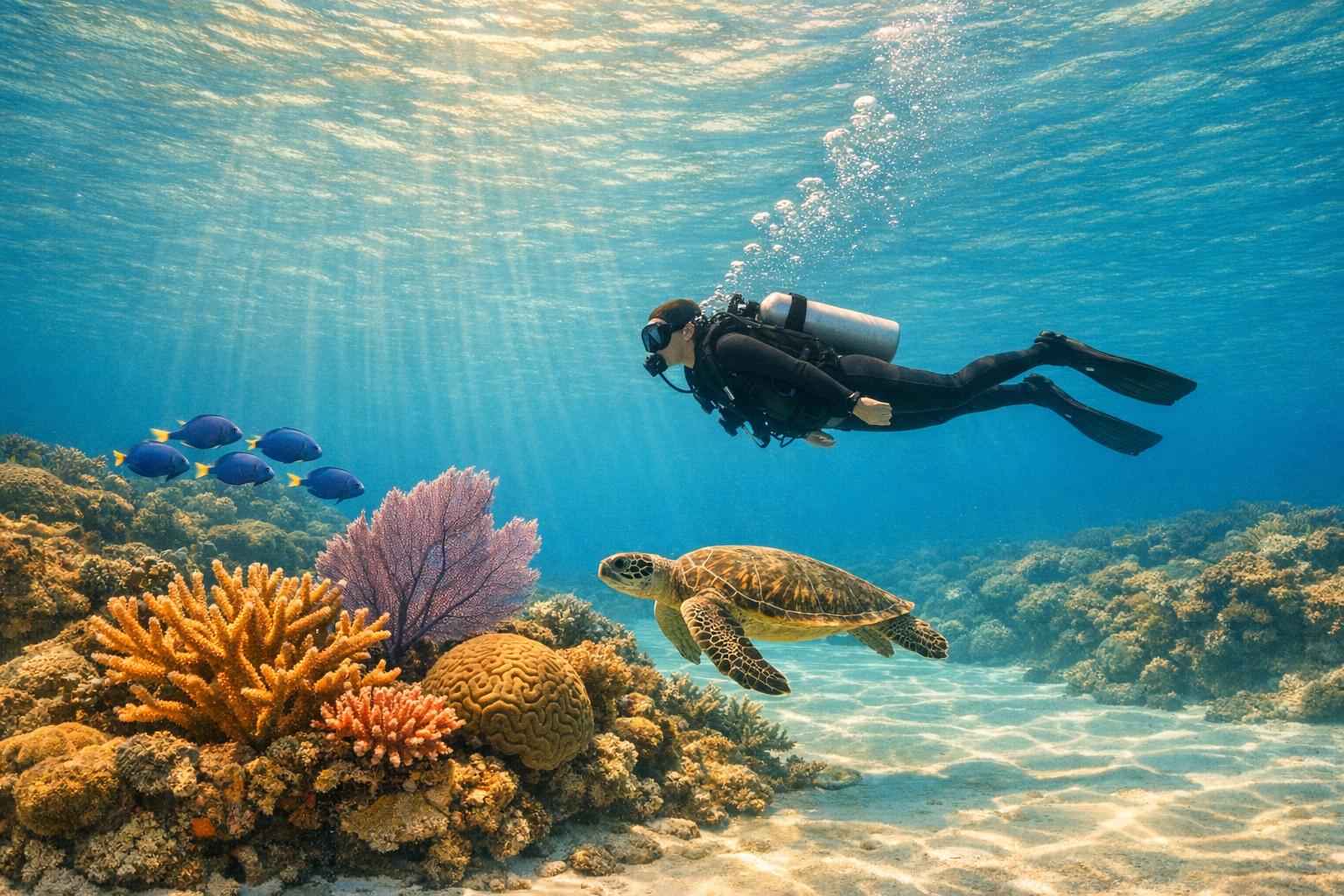
Playa del Carmen is a prime destination for scuba diving in 2026, offering stunning coral reefs, mystical cenotes, and diverse marine life. Whether you're a beginner or an experienced diver, this guide covers everything you need to know to plan your trip. Here's a quick overview:
- Reefs: Dive into the Mesoamerican Barrier Reef, home to vibrant corals, turtles, rays, and seasonal bull sharks (November–March). Top sites include Chankanaab Reef, Palancar Reef, and Santa Rosa Wall.
- Cenotes: Explore the Yucatán's freshwater sinkholes, featuring crystal-clear water, stalactites, and unique haloclines. Popular spots include Dos Ojos, Chac Mool, and Angelita.
- Conditions: Ocean temperatures range from 24°C to 30°C, with visibility up to 35 meters. Cenotes maintain a steady 24°C with visibility exceeding 50 meters.
- Costs: Reef dives cost $85–$100 USD (two tanks), while cenote tours are around $165 USD. Weekly dive packages range from $400–$600 USD.
From warm waters to reliable dive operators like Seth Dive Mexico, Playa del Carmen offers unforgettable underwater experiences. Keep reading for detailed dive site reviews, safety tips, and booking advice.
Diving in Playa del Carmen - Reef & cenotes
sbb-itb-8d6faf7
Why Choose Playa del Carmen for Diving in 2026
Playa del Carmen is a diver’s paradise, offering year-round opportunities thanks to its tropical climate. Even when the weather isn’t ideal, cenote diving remains a dependable option. As Deep Mexico explains:
"Cenotes are unique in the world and have a huge advantage: they do not depend on the outside weather." [6]
What makes this region special is its incredible variety: vibrant coral reefs, crystal-clear cenotes, and seasonal encounters with bull sharks. Bull shark diving is available from November to March [9], while loggerhead and green turtles nest along the coastline from May to September [13]. For those visiting between June and September, snorkeling with whale sharks is an option, though interactions are strictly regulated [6]. These natural highlights make Playa del Carmen a must-visit destination for divers in 2026.
Water Conditions and Visibility
The water in Playa del Carmen stays warm throughout the year, making diving comfortable in any season. Ocean temperatures range from 26°C (79°F) in winter to 30°C (86°F) in summer [10][11], while cenote waters remain steady at 25–26°C (77–79°F) year-round [8][9]. For winter dives, a 3mm or 5mm wetsuit is recommended, but in summer, a shorty or rash guard is usually enough [6][12].
Visibility is another major draw. Ocean dives typically offer 20–30 meters of visibility, with winter months (December through March) often reaching up to 35 meters [10][11]. Cenotes, on the other hand, boast exceptional clarity, with visibility often exceeding 50–60 meters - perfect for underwater photography [6][10].
2026 Diving Regulations and Fees
To maintain safety and protect the environment, diving in Playa del Carmen adheres to strict regulations. All divers must complete a standard PADI Medical Questionnaire, and any “yes” answers require a doctor’s approval [14][15]. Alcohol is off-limits for 8–24 hours before diving, and after your last dive, you’ll need to wait 18–24 hours before flying [14][15].
Marine park and dock fees are part of the experience. While marine park fees are often included in dive packages, dock fees - usually around $15.00 USD - may need to be paid on-site, even if your tour is prepaid [14]. A week of diving, covering 6 to 8 dives across reefs, cenotes, or Cozumel sites, typically costs between $400 and $600 USD [12]. To ensure a safer and more personalized experience, groups are usually limited to four divers per instructor [16].
Environmental rules are strictly enforced, especially at popular spots like "Shark Point", a bull shark dive site at 24 meters deep. Divers are required to stay still - kneeling or lying down - to avoid disturbing the sharks [12]. Ethical operators refrain from using feeding or attractants, ensuring a natural and respectful interaction [9][12]. For whale shark encounters, snorkeling is the only option, as mandated by federal law [6].
With its rich marine life, warm waters, and clear regulations, Playa del Carmen offers an unforgettable diving experience in 2026.
Best Coral Reef Dive Sites in Playa del Carmen
Playa del Carmen is perched along the Mesoamerican Barrier Reef, a sprawling underwater ecosystem that extends over 600 miles. This reef is home to an incredible array of marine life, including more than 65 species of stony corals, 350 mollusks, and 500 species of fish [17][19]. From the dramatic drop-offs of Cozumel to the intricate coral formations closer to shore, the area offers something for every diver. Here’s a closer look at some of the standout reef sites, catering to different skill levels.
Chankanaab Reef and Palancar Reef
Chankanaab Reef is located right in front of Chankanaab Park and sits at depths of 11–18 meters. Its calm waters and shallow coral formations make it a great choice for beginners and night dives. The reef is teeming with marine life, including spiny lobsters and the rare Splendid Toadfish [20]. With mild currents and excellent visibility, it’s a welcoming spot for those new to diving.
Palancar Reef, on the other hand, is a vast and dynamic reef system stretching over 3.5 miles. Depths range from 10 to 40 meters, offering a mix of colorful coral formations, tunnels, and vibrant sponges in shades of orange and purple. During the winter months (November to March), eagle rays are a common sight here [17][18]. While the shallower sections are beginner-friendly, the deeper areas with stronger currents are best suited for intermediate and advanced divers.
Santa Rosa Wall and Paradise Reef
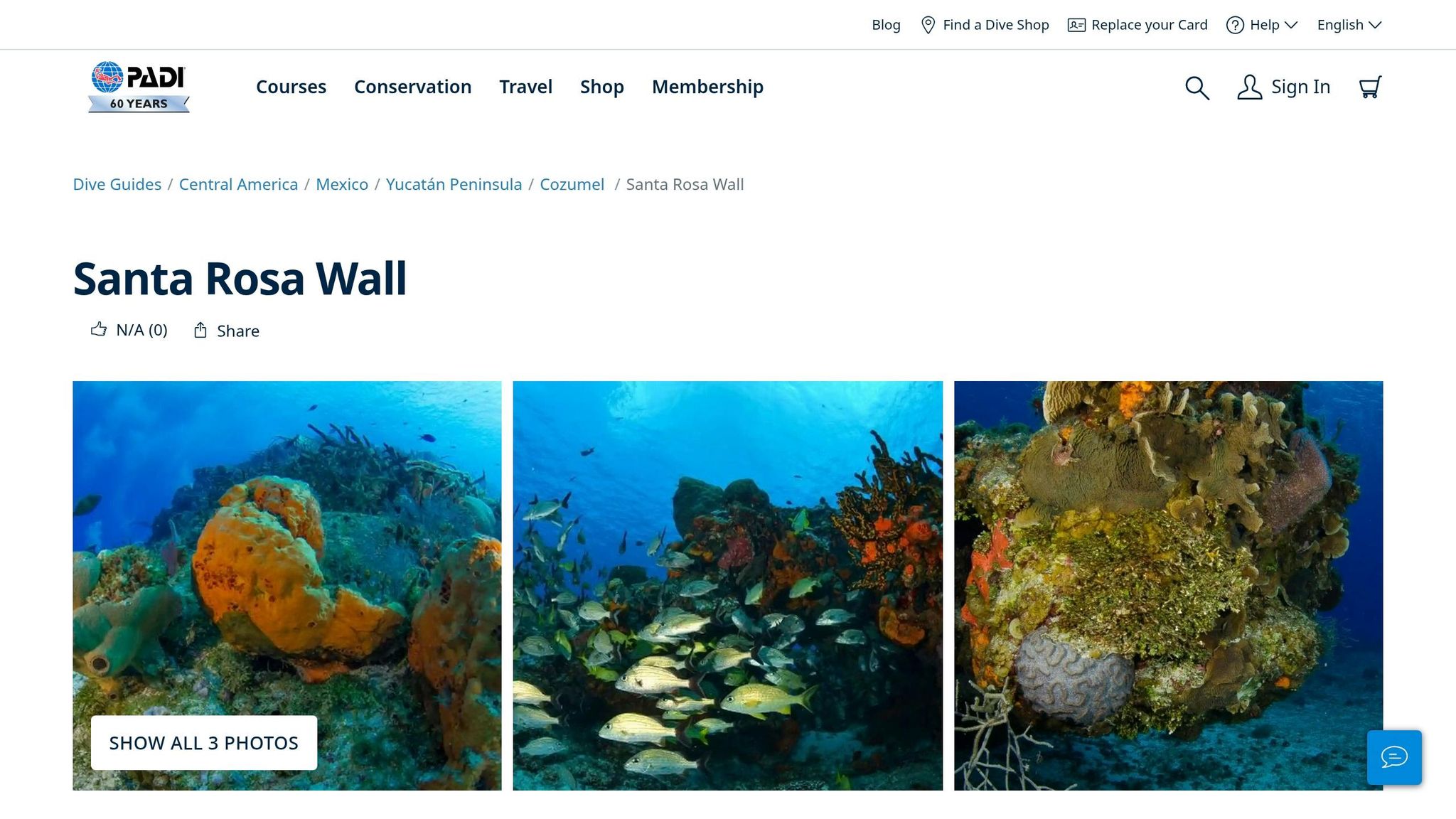
Santa Rosa Wall is a breathtaking vertical drop-off that begins at 15–18 meters and descends to 40 meters. Known for its dramatic walls, large tunnels, and moderate to strong currents, this site is ideal for intermediate and advanced divers. Visibility often exceeds 30 meters, revealing eagle rays, groupers, and massive sponges [18][20]. Due to heavy boat traffic and drift conditions, divers are advised to use a surface marker buoy (SMB) [18].
Paradise Reef is a collection of three separate reefs running parallel to the shore, with depths ranging from 14 to 18 meters. It’s particularly popular for night dives, thanks to its easy access and lively nocturnal marine life. Expect to encounter schools of tropical fish, crabs, lobsters, and occasionally the elusive Splendid Toadfish hiding beneath ledges [20]. This site is well-suited for both novice and intermediate divers.
Local Coastal Reefs
The local reefs near Playa del Carmen are just a short boat ride from shore, making them a convenient option for divers who want to skip the ferry to Cozumel. Jardines Reef (9–12 meters) is perfect for beginners, with its vibrant coral gardens and schools of tropical fish. For those seeking more depth, Moc-Che Deep (21–27 meters) offers large barrel sponges and frequent turtle sightings. Meanwhile, Pared Verde (18–30 meters) provides an exhilarating drift dive along a vertical wall, where green moray eels and stingrays are often spotted [21]. A 2-tank boat dive at these local sites typically costs around $100 USD [9].
Cenote Diving Near Playa del Carmen
If you’re looking for an adventure that’s different from the vibrant coral reefs, cenote diving offers a unique experience. Instead of exploring the open ocean, you’ll find yourself diving into freshwater sinkholes surrounded by limestone. The Yucatán Peninsula is home to nearly 10,000 cenotes, and the visibility here is incredible - often exceeding 30 to 50 meters, thanks to the natural filtration of limestone [25]. These calm, clear waters are free of currents, making them ideal for diving.
Cenotes aren’t just beautiful; they’re packed with fascinating features. You’ll swim among stalactites, stalagmites, and stunning light displays. And then there’s the halocline - a shimmering layer where freshwater meets saltwater, usually found 10 to 20 meters below the surface [25]. From beginner-friendly caverns to advanced cave systems, there’s a cenote for every skill level. Here are some standout spots to add to your diving list.
Chac Mool and Kukulkan Cenotes
Chac Mool is a favorite for first-time cavern divers. With a maximum depth of about 14 meters, it’s perfect for beginners [24]. The cenote features cavern passages, air domes, and a dramatic halocline effect. Entrance fees are about $10 USD for adults and $5 USD for children under 12. If you need gear and a guide, expect to pay around $30 USD [23]. With a stellar 5/5 rating from 1,738 reviews [22], it’s a top pick. Arriving early, around 8:00 AM, not only beats the crowds but also offers the best natural light [23].
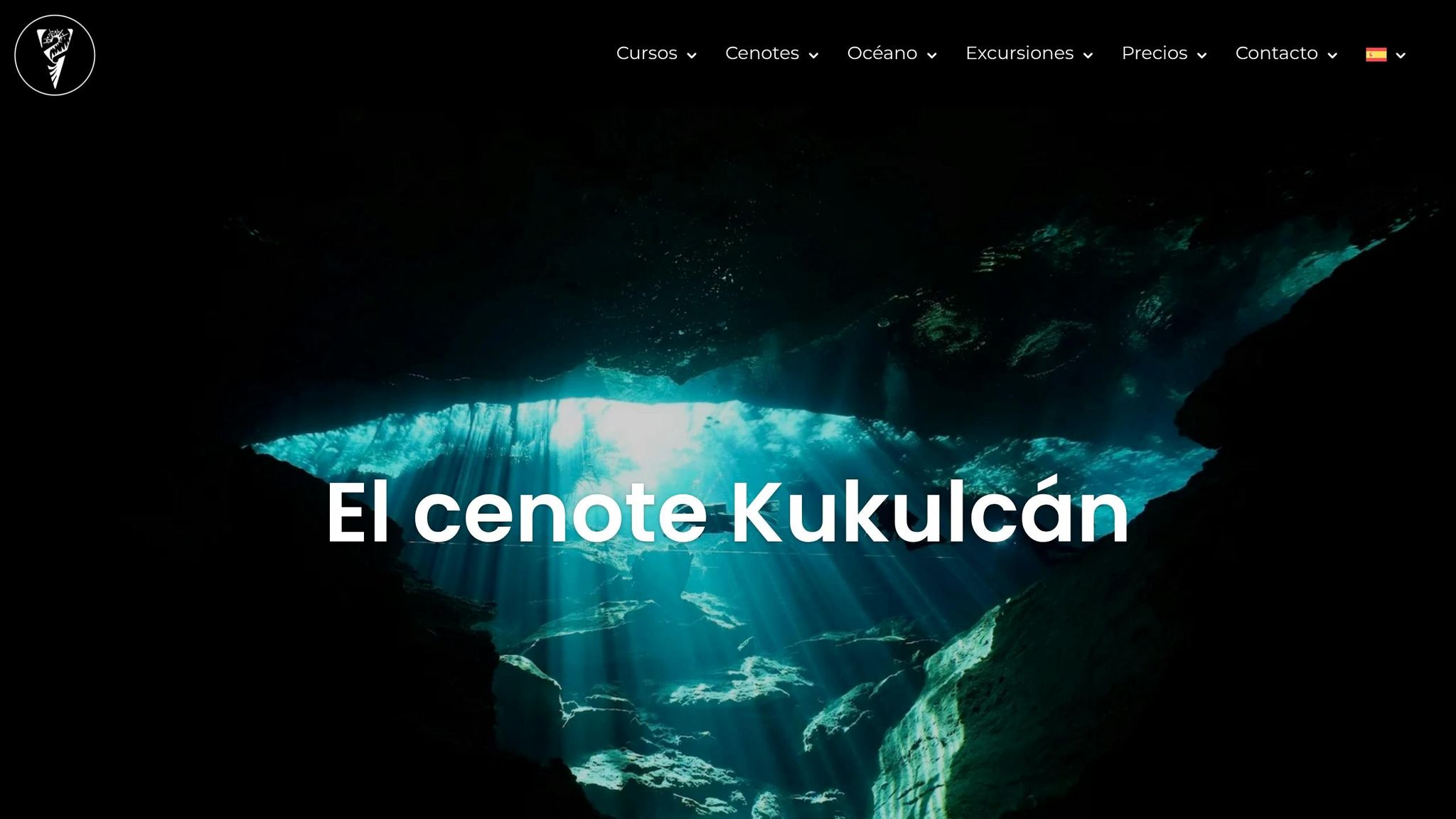
Kukulkan, located next to Chac Mool, is famous for its dazzling light beams, often called a "laser show." Photographers especially love the intense sunbeams that shine through the ceiling, which are at their best from March to September during midday [23][3]. Kukulkan’s shallow depths and impressive stalactites make it an excellent choice for divers with basic cavern certifications. Ratings hover between 4.7 and 4.8 stars [22].
Angelita and The Pit
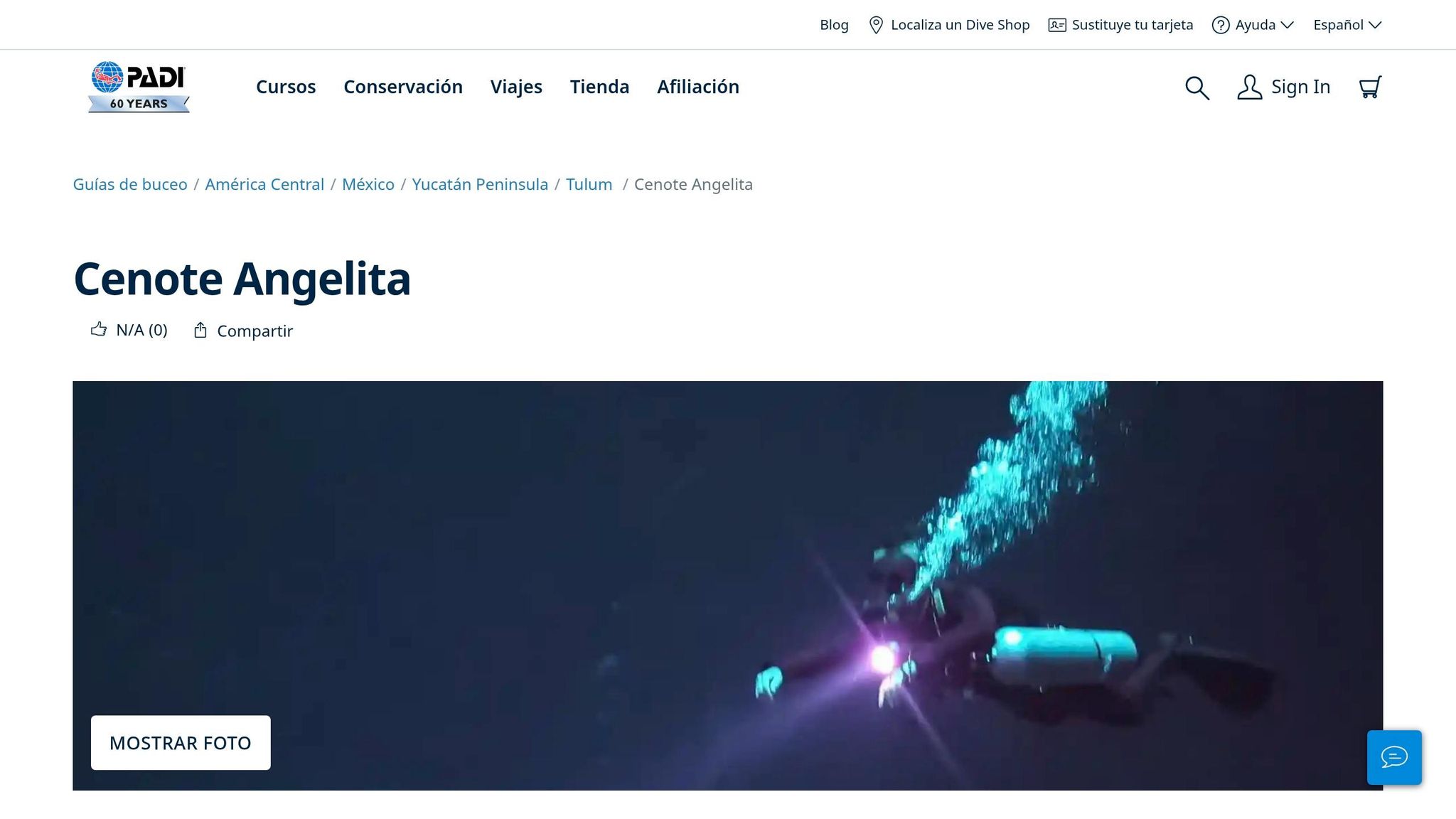
Angelita is a dive for the more experienced. At a depth of around 30 meters, you’ll encounter a surreal hydrogen sulfide cloud that creates an almost otherworldly effect. Because of the depth and overhead environment, this dive requires cave or technical diving certifications. Prices for advanced dives at Angelita range from 3,800 to 4,250 MXN (about $205 to $230 USD).
The Pit is a massive sinkhole that plunges beyond 30 meters, offering a cathedral-like environment. Light beams pierce through the water, creating a striking visual as you descend into the depths. This dive is only for those with advanced training in deep diving. Both Angelita and The Pit demand excellent buoyancy control and specialized insurance for overhead environments [2].
Dos Ojos Cenote
Dos Ojos, meaning "Two Eyes", is part of the world’s third-largest underwater cave system, with over 8 kilometers of explored passages [2]. Its name comes from two large, circular sinkholes connected by underwater tunnels. The site includes vast chambers like the famous Bat Cave and offers routes suitable for all certified cavern divers. Visibility is exceptional, and the scale of the system makes it a must-visit. Entrance fees range from 400 to 500 pesos (around $24 to $30 USD) [28].
The cenote caters to both shallow and deeper dives, giving you flexibility in planning. Gear rental typically costs around $20 USD [27], while guided dives range from 3,400 to 3,800 MXN (approximately $185 to $205 USD). Facilities such as parking, bathrooms, and gear-up tables are available at most cenotes, including Dos Ojos [23][24].
Marine Life in Reefs vs. Cenotes
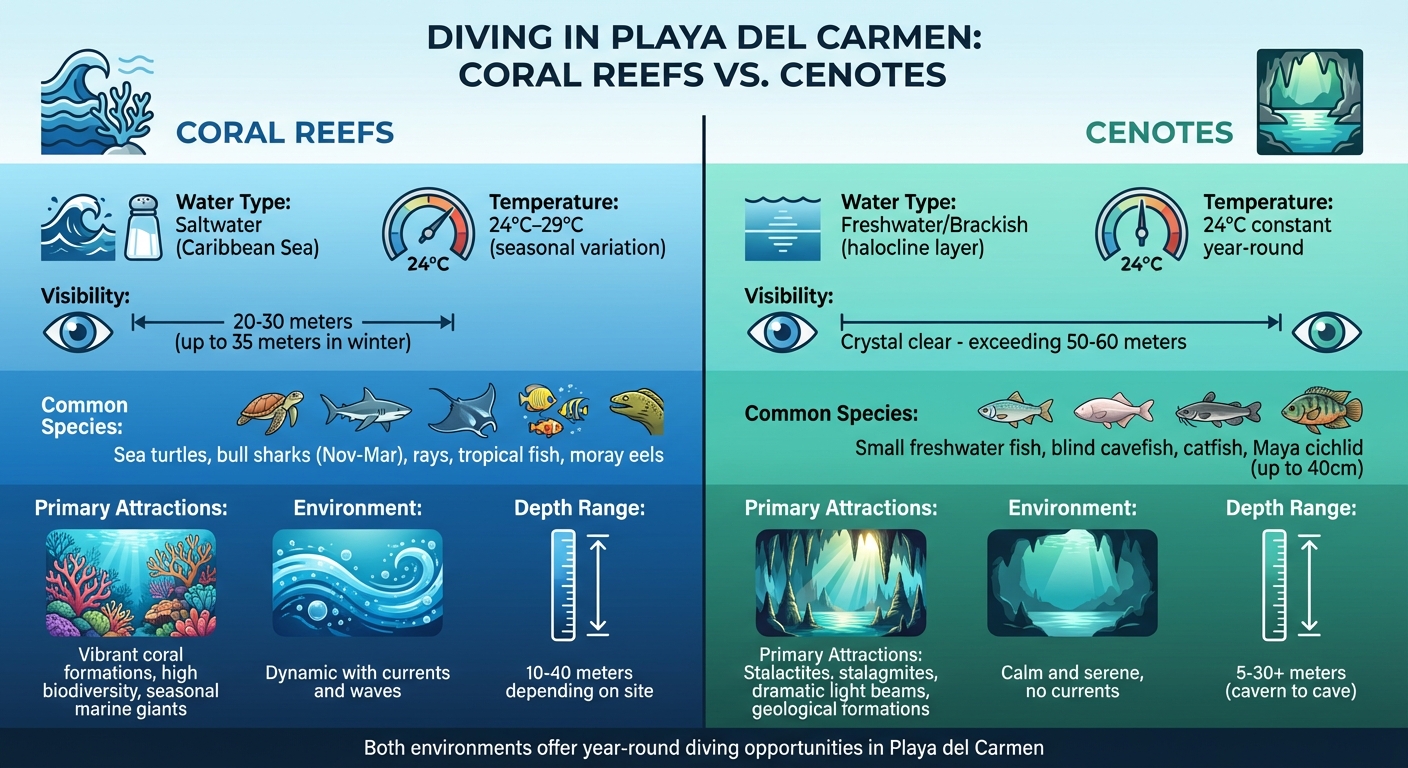
Coral Reefs vs Cenotes: Complete Diving Comparison in Playa del Carmen
Diving in Playa del Carmen offers two distinct underwater worlds: ocean reefs and cenotes. Each has its own charm and unique marine life, making both experiences unforgettable.
Coral reefs are bustling with activity. Picture sea turtles gliding effortlessly, rays sweeping over sandy bottoms, and tropical fish weaving through colorful coral formations. You might even spot moray eels hiding in crevices or, during winter, bull sharks making an appearance [3].
Cenotes, on the other hand, provide a more serene and otherworldly experience. These freshwater sinkholes may host fewer species, but they offer rare and fascinating encounters. The Yucatán boasts 23 native freshwater fish species, with 7 found nowhere else on the planet [31]. In these crystal-clear waters, you might come across small catfish, blind cavefish adapted to the darkness, or even the Maya cichlid, which can grow up to 40 cm long [31]. Some cenotes are home to endangered species like the "Blind White Lady" (Blind Brotula) and the "Yucatan Blind Eel" [30]. Above the water, you might catch a glimpse of bats, iguanas, or the vibrant "Toh" bird (Motmot) [30][31].
The environments of reefs and cenotes shape their ecosystems. Reefs thrive under full sunlight, with temperatures ranging from 24°C to 29°C depending on the season. Cenotes, however, maintain a constant 24°C, with dramatic light beams piercing through their openings [2][6][32][3]. Reefs are dynamic, influenced by currents and waves, while cenotes are calm and tranquil [32].
Here’s a quick comparison of the two environments:
| Feature | Coral Reefs | Cenotes |
|---|---|---|
| Water Type | Saltwater (Caribbean Sea) | Freshwater / Brackish (halocline) |
| Temperature | 24°C–29°C (seasonal) | 24°C (constant) [2][6] |
| Common Species | Sea turtles, sharks, rays, tropical fish, moray eels | Small freshwater fish, blind cavefish, catfish [3] |
| Primary Attractions | Vibrant coral, high biodiversity, seasonal giants | Stalactites, stalagmites, light beams, geological formations |
| Visibility | High (varies by season/current) | Crystal clear – over 60 meters [6] |
| Environment | Dynamic (currents/waves) | Calm and serene [32] |
Whether you're drawn to the lively, colorful reefs or the peaceful, mysterious cenotes, Playa del Carmen has something for everyone.
A quick reminder: cenotes are delicate ecosystems. Avoid wearing sunscreen or oils - even eco-friendly ones - when diving in cenotes, as they can harm the fragile freshwater environment [2]. Similarly, when encountering sea turtles during reef dives, keep a respectful distance, particularly during nesting season [29].
Safety Guidelines for Cenote Diving
Cenote diving in Playa del Carmen is an adventure like no other, blending natural beauty with a technical edge. Since cenotes are confined spaces, diving here requires strict safety measures, proper training, and specialized equipment. With the right preparation, cenote diving can be both safe and incredibly rewarding.
"Cavern diving is not something to mess around with. Choose your cenote guide very wisely." - Claire Summers, Travel Expert [4]
Certification and Depth Requirements
To dive in cenotes, you'll need at least an Open Water Diver certification, which is enough for most recreational cenote dives [25][26]. Popular sites like Dos Ojos and Chac Mool fall into this category, as they allow you to stay in the "daylight zone", meaning you'll always remain within 60 meters of natural light [33]. These dives typically range from depths of 5 to 20 meters.
If you're aiming for more challenging cenotes, such as The Pit, Angelita, or Zapote, you'll need an Advanced Open Water Diver (AOWD) certification [25][26]. These cenotes can reach depths of 30 to 40 meters and demand more diving experience. For beginners, some operators offer "Discover Scuba Diving" sessions in shallow, open cenotes under close instructor supervision [25][4].
For those venturing into fully dark, narrow passages beyond the natural light zone, a Full Cave Certification is mandatory. This level of diving is highly technical and requires extensive training [26][2].
Safety is a top priority: groups are limited to a maximum of 4 divers per guide [26], and guides must hold Full Cave Diver certifications along with Divemaster or Instructor qualifications [33]. During dives, you'll rely on a continuous guideline for navigation [33]. Once certified, you'll also need to ensure your equipment is properly adjusted for cenote conditions.
Required Equipment for Cenotes
While standard scuba gear works, cenote diving calls for a few adjustments. A wetsuit is essential, as freshwater feels colder than seawater, even though cenote water remains a steady 24–26°C throughout the year [26][33][25].
Here’s a quick checklist of what you’ll need:
- A reliable BCD (buoyancy control device)
- Regulator with an octopus
- Dive computer
- Mask and fins
- At least one primary dive torch (plus a backup light)
Your guide will handle the guideline system [2][33]. Additionally, you'll need to tweak your weight setup. Since freshwater is less buoyant than saltwater, you’ll require less weight than you would for ocean dives. It’s a good idea to fine-tune your buoyancy at the start of the dive [25].
Don’t forget to budget for extra costs like cenote entrance fees (250–500 MXN) and equipment rentals (300–500 MXN for cameras), which are usually paid in cash [33][25][26]. By following these guidelines and preparing thoroughly, you’ll set yourself up for a safe and unforgettable cenote diving experience.
Planning Your Reef Dives
Reef diving in Playa del Carmen is simple and well-organized. Dive centers usually provide an exact GPS location and meeting time a day before your scheduled trip [34]. A standard 2-tank reef dive typically takes about 4 to 5 hours, covering a briefing, a short boat ride, two dives, and a surface interval with refreshments [5]. Make sure to bring your certification card and logbook before heading out [7]. Planning your reef dives this way ensures your overall dive itinerary in Playa del Carmen flows smoothly, allowing you to fully immerse yourself in its underwater marvels.
Boat Rides and Private Charters
Reef sites are conveniently located near downtown marinas. For example, Jardines Reef, Sabalos, and Tortugas are only 5, 10, and 15 minutes away by boat, while Cerebros is a bit farther, at around 35 minutes [34]. If you're looking for a tailored experience, many operators offer private charters for small groups of two or more divers, providing a personal guide for your trip. Solo divers are generally placed in small groups with a maximum of four divers per guide, ensuring safety and close attention [34][7]. Prices for a typical 2-tank reef dive range from $99.00 to $109.00 USD (approximately $3,500.00 MXN), with equipment rental costing an additional $25.00 USD if not included [5][34].
Best Times to Dive
Timing plays a crucial role in getting the best underwater conditions. Morning dives are highly recommended, as the water is calmer, winds are lighter, and visibility is at its peak before afternoon weather changes [5][35]. During the dry season, which runs from November to April, visibility can reach up to 30 meters - perfect for exploring the reefs. Water temperatures vary between 24°C in the winter and 29°C in the summer [5][6]. If you're diving during the rainy season (May to October), it's best to start early to avoid afternoon rain showers. And if strong winds cause marina closures for ocean dives, cenote diving remains a fantastic alternative since it's unaffected by sea conditions [12].
Seth Dive Mexico: Private Diving Services
Seth Dive Mexico specializes in private, small-group diving adventures in Playa del Carmen, with a solid foundation of 20 years of experience and over 8,000 dives under their belt. They stick to a strict limit of 4 divers per guide for all scuba and Discover Scuba programs, ensuring a highly personalized experience. Whether it's the vibrant reefs of the Mesoamerican Barrier Reef or the mesmerizing cenotes like Dos Ojos and The Pit, every dive is tailored to provide the best possible experience[36].
Each tour includes everything you need: full equipment rental, entrance fees, round-trip hotel pickup (covering areas from Cancún to Tulum), and refreshments[37]. They also cater to an international audience with multilingual briefings in English, Spanish, French, German, Italian, and Portuguese[39]. Unlike rigid, fixed-schedule group tours, Seth Dive Mexico lets you customize your itinerary, including the unique option for sunrise dives at select cenotes[36].
Dive Plans and Pricing
Seth Dive Mexico has options for divers of all levels, offering a variety of experiences to suit different preferences.
- Cenote Diving: Prices range from $185 to $225 USD (around $3,300 to $4,000 MXN) for a 2-tank dive, with access to over 20 cenotes[36].
- Ocean Reef Diving: Starts at $125 USD for a 2-tank guided dive.
- Cozumel Diving: Costs $195 USD, including a direct boat ride from Playa del Carmen (no ferry needed)[36].
For those just starting out, the Discover Scuba program is available at $135 USD for cenote dives and $140 USD for ocean dives, complete with full instruction[36]. If you're looking to get certified, PADI courses start at $400 USD for the Open Water (3-day course) or Advanced Open Water (2-day course). You can even complete the eLearning portion at home before your trip[36].
Prefer snorkeling? Cenote snorkeling tours range from $90 to $150 USD, and they're always private for your group, with lunch included[36]. For an extra $100 USD, you can make any scuba tour fully private, ensuring exclusivity for your group[36]. Peak season (December to April) is busy, so booking 2 to 3 weeks ahead is recommended to lock in your preferred dates[37].
Why Choose Private Diving with Seth Dive Mexico?
Private tours come with a host of perks. You decide the pickup time and dive sites, giving you the freedom to plan sunrise cenote dives or adjust based on weather conditions[40]. The company has earned a stellar reputation, holding a 4.9/5 rating on TripAdvisor, an eight-year streak of Travelers' Choice awards, and a perfect 5.0/5 rating on Google[40].
"Best dive operator in the Riviera Maya, hands down. Private tour made all the difference." - Stefan K., Switzerland[36]
All guides are fully cave-certified professionals with deep knowledge of local dive sites, ensuring safe and expert navigation through even the most complex spots like Angelita and The Pit[40]. Cenote dives remain within the "cavern zone", where natural light is always visible, and safety is prioritized with permanent guidelines and backup lights provided by the guides[38]. Plus, with their all-inclusive pricing, you won't encounter hidden fees - everything from equipment to entrance costs is included[40].
Booking Your 2026 Dive Trip
Planning your dive trip is incredibly straightforward. Just follow these three steps: send us a message with your travel dates, accommodation details, and your diving interests; receive a tailored recommendation and quote; and confirm your booking. From there, we handle everything - gear setup, hotel pickup, and more - so you can focus entirely on the adventure ahead [40]. For quick responses, reach out via WhatsApp at +52 998 399 6705 [40][38].
If you're traveling during the peak season (December through April), timing is key. This is the busiest period, and spots fill up fast, so booking 2 to 3 weeks in advance is highly advised [37]. Let us know your specific interests - like diving with bull sharks (November–February) or catching the cenote light shows (March–September) - when you first contact us, and we’ll craft an itinerary that suits your preferences.
Want to mix things up? Combining reef and cenote dives in one trip is a fantastic way to experience the region’s underwater diversity. A weeklong trip can include both ocean dives and cenote explorations. If you're looking to get certified, the Open Water Certification course ($400+) spans three days and covers both environments, giving you the best of both worlds. Already certified? Seth Dive Mexico will create a personalized schedule just for you, so you’re not stuck with rigid group itineraries [40].
For those pursuing PADI certification, completing the eLearning module before your trip is a huge timesaver. It frees up 1 to 2 days of vacation time, letting you dive right in [39]. Don’t forget to pack essentials like biodegradable sunscreen (regular sunscreen is prohibited in cenotes), a swimsuit, a towel, and a change of clothes [38][41]. Morning cenote trips typically start with an 11:00 AM pickup, so plan accordingly [40].
Your booking includes free round-trip hotel pickup from Cancún to Tulum, plus all-inclusive pricing that covers equipment rental, entrance fees, and refreshments [40][37]. Want a private scuba diving experience? Add $100 to make it exclusively for your group [40][37]. These details ensure your dive trip is as seamless and enjoyable as possible.
Conclusion
Playa del Carmen offers an incredible range of diving experiences, making it a standout destination for underwater enthusiasts. Here, you can explore two vastly different aquatic worlds: the vibrant Mesoamerican Barrier Reef - the second-largest reef system on the planet - and the mystical cenotes, unique to the region [1][2]. Whether you're gliding along the colorful coral walls of Paradise Reef or venturing into the ancient limestone formations of Dos Ojos, there's something for every diver.
The area's diving conditions cater to adventurers year-round. Depending on the season, you might encounter bull sharks from November to March, swim alongside sea turtles between May and September, or spot majestic whale sharks from June through September [6][3]. And thanks to the stable environments of the cenotes, you can enjoy consistent diving conditions no matter when you visit.
Seth Dive Mexico ensures your experience is seamless from start to finish. Their all-inclusive packages cover everything: private guides, flexible schedules, personalized itineraries tailored to your skills and interests, and even hotel pickups from Cancún to Tulum. Forget about rigid group schedules or surprise fees - small group sizes guarantee safety and individual attention, whether you're enjoying beginner-friendly dives like Jardines Reef or taking on advanced challenges like The Pit.
With all the details handled for you, planning your dive trip is effortless. Ready to take the plunge? Reach out via WhatsApp at +52 998 399 6705 for fast responses and personalized advice. If you're visiting during the busy season (December–April), booking 2 to 3 weeks in advance is recommended to lock in your preferred dates. Start planning your 2026 dive adventure today!
FAQs
Reefs or cenotes: which should I do first?
For those just starting out, reef diving is the way to go. Reefs are typically shallow - about 12 meters deep - calm, and teeming with colorful marine life. This makes them perfect for gaining confidence underwater. On the other hand, cenote diving, with its stunning cave-like formations, demands more advanced experience and specific techniques. Start with reef dives to build your skills, and once you're comfortable with open water, you can take on the challenge of cenotes.
What certification do I need for each cenote?
To explore cenotes through diving, you need to have an Open Water certification or an equivalent qualification. This certification guarantees that you possess the essential skills and training required to safely navigate these extraordinary underwater settings.
How many days should I plan for diving?
Plan to dedicate at least 4 days of diving to truly experience the underwater wonders of Playa del Carmen. This timeframe allows for approximately 8 dives, which is a typical number included in advanced diving packages. With this, you'll have the opportunity to explore the area's incredible variety, from vibrant reefs to mystical cenotes and thrilling advanced dive sites.
Frequently Asked Questions
Can a complete beginner with no scuba experience dive in Playa del Carmen?
Yes — Discover Scuba Diving programs let complete beginners dive in shallow, open cenotes or the ocean under direct instructor supervision, with no prior certification needed. Seth Dive Mexico offers this starting at $135 USD for cenotes and $140 USD for ocean dives, with all gear and instruction included.
Do I need to rent a car to get to the cenotes from Playa del Carmen?
No rental car is needed if you book with an operator that includes hotel pickup. Free round-trip transportation from anywhere between Cancun and Tulum is included in every tour, so you just share your hotel or Airbnb address when booking and a driver handles the rest.
Is it safe to dive with bull sharks in Playa del Carmen?
Bull shark dives at sites like Shark Point (24 meters) are conducted under strict protocols — divers kneel or lie still on the bottom, and ethical operators never use feeding or attractants to draw the sharks in. The season runs November through March, and an Advanced Open Water certification is recommended for the depth involved.
What is the difference between cavern diving and cave diving in a cenote?
Cavern diving keeps you within 60 meters of natural light and is accessible to Open Water certified divers — popular sites like Dos Ojos and Chac Mool fall into this category. Full cave diving ventures beyond natural light into narrow, dark passages and requires a specialized Full Cave Diver certification that goes well beyond recreational training.
Can I combine reef diving and cenote diving in the same trip?
Absolutely — most visitors split a week-long trip between both environments, and a guide can build a schedule around your certification level, interests, and travel dates. Morning cenote trips pair naturally with afternoon reef dives on different days, giving you a complete picture of the Riviera Maya underwater.
How far in advance do I need to book diving in Playa del Carmen?
During peak season from December through April, booking 2 to 3 weeks ahead is strongly recommended because private and semi-private spots fill quickly. Outside peak season, a week's notice is usually sufficient, though messaging with your dates and hotel as early as possible gives you the most itinerary flexibility.