How to Choose a Dive Shop in Playa del Carmen
Choose a dive shop in Playa del Carmen by certification, group size, safety checks, and full pricing before you book.
How do you choose the right dive shop in Playa del Carmen?
The right dive shop in Playa del Carmen matches the trip to your certification, recent dive history, and comfort level, then explains safety procedures, group size, and the full price before you pay. Immersive Mexico's 10-point framework, published 07/22/2026 by dive writer Gigi of GigiScubaTravel, frames the decision this way rather than ranking shops by price or social media presence.
That distinction matters because a web search for scuba diving in Playa del Carmen turns up, in Beyond Diving's words, "hundreds, if not thousands" of results, and not every operator asks what you actually need before booking you onto a trip. The ten checks in Immersive Mexico's framework cover credentials, screening questions, group size, equipment condition, how sites get chosen on the day, and whether the quoted price hides extra fees.
The sections below walk through the checks that matter most on a short vacation, plus how to verify a shop's PADI status and figure out which specific dive sites fit your certification before you ever call.
What should you ask a Playa del Carmen dive shop before booking?
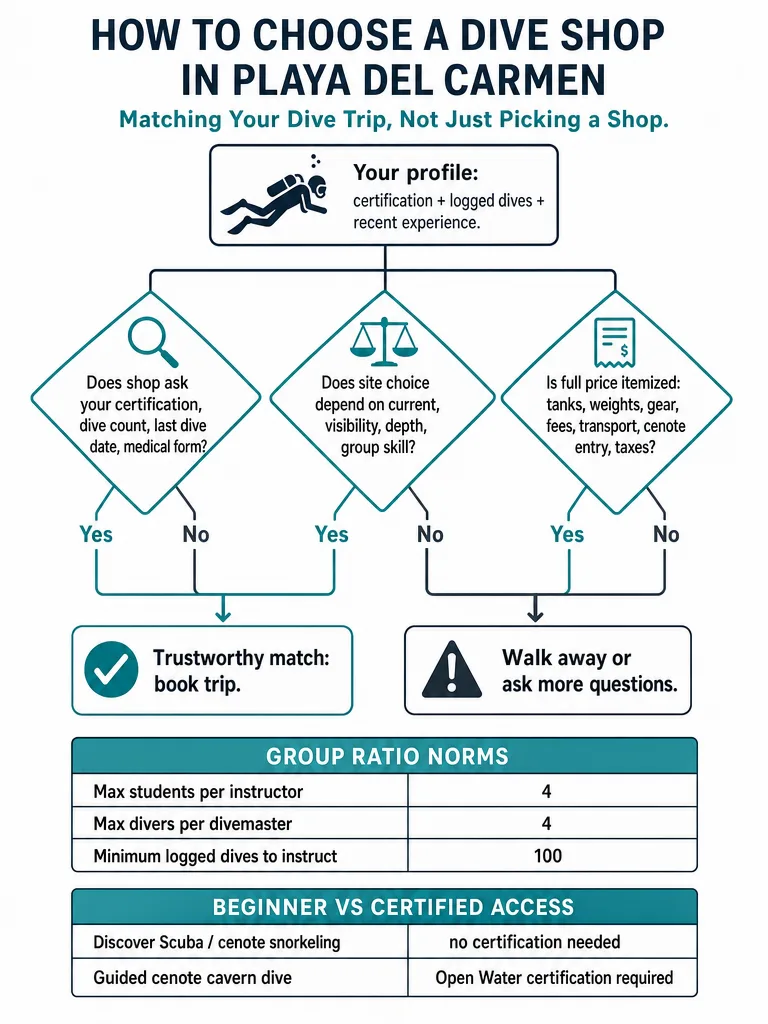
A trustworthy operator asks you questions before recommending a dive, and you should ask a few back. Immersive Mexico's screening list centers on certification, logged dives, and recent experience; Beyond Diving adds direct questions about legal status and instructor background. Treat a shop that skips this screening and promises every site to every caller as a warning sign.
Before you book, expect, or ask, these five questions:
- What certification do you currently hold, and can you confirm the card level, Open Water, Advanced Open Water, or none?
- How many dives have you logged, and roughly how recently did you last dive?
- Have you dived in current, from a boat, or in an overhead environment like a cavern?
- Do you have a medical condition or take medication that affects the standard dive medical screening form?
- Which credential does the guide leading your specific activity hold, since an introductory dive, a reef trip, and a cenote cavern route each require a different qualification?
Then verify the shop's side independently: confirm its listing through PADI, the Professional Association of Diving Instructors' own directory, and ask which store it operates under. PADI states that dive centers in its Playa del Carmen directory adhere to PADI's quality standards.
How many divers will be in your group?
Group size, not the word "small," determines how much attention you get underwater. Sources on Playa del Carmen diving don't fully agree on hard ratio limits, so the safer approach is asking your specific shop for the exact number before booking rather than accepting "small groups" at face value.
Beyond Diving publishes one commonly cited standard:
| Role | Maximum ratio |
|---|---|
| Instructor teaching students | 4 students per instructor |
| Divemaster or guide on a certified dive | 4 divers per guide |
Beyond Diving separately notes that most recreational training agencies require a minimum of 100 logged dives before someone can train to become an instructor. That's a prerequisite for teaching, not a rule about how many dives a guide needs to lead a certified group dive, and it's not a universal regulation across every agency. Ask directly: what is the diver-to-guide ratio on my trip, and will I be grouped with similar experience levels?
Is a PADI-listed dive shop safer, and how do you verify it?
A PADI-listed dive shop is one that appears in the Professional Association of Diving Instructors' own directory, and PADI states that dive centers listed there adhere to its quality standards for instructor training, safety, and equipment. Being PADI-listed is a verifiable baseline, not a guarantee that nothing can go wrong, but it rules out a meaningful category of risk before you book.
Verification takes two minutes. Deep Mexico, in a guide published 05/19/2026, describes a PADI-registered dive shop as one that has met strict international standards for safety, equipment, and instructor training, and notes that every legitimate PADI dive shop has a unique store PIN you can search directly on padi.com. Deep Mexico publishes its own PIN as an example of what a shop should hand over without hesitation. If a company can't give you that number, treat it as a red flag rather than an oversight.
The second check is independent of PADI entirely: search the company name on Google Maps and Google Business. A real Playa del Carmen operator shows a physical address, operating hours, and reviews spread across different months and years, a history that Deep Mexico notes is difficult to fake overnight.
Can beginners scuba dive in Playa del Carmen, or do you need certification first?
Beginners without any certification can scuba dive in Playa del Carmen through a Discover Scuba program, which introduces first-timers to breathing underwater under direct instructor supervision and requires no card. Guided cenote cavern dives work differently: Scuba Playa states plainly that its cenote dives are for certified divers only, and that an Open Water Diver certification is sufficient for its guided cenote cavern routes, since the dive runs through underwater cave systems that a specialized cavern guide navigates, not open ocean.
That split covers most of what vacationers ask. A Discover Scuba session is the right starting point if you've never used scuba gear and want a taste of breathing underwater before committing to a course. A cenote cavern dive is the right fit once you hold Open Water or higher. Cenote snorkeling, which doesn't involve scuba gear, is a separate option worth asking an operator about if you want to see a cenote without diving.
If you're arriving uncertified but already know you want the deeper cenotes and reef sites, the best PADI course to finish before a Riviera Maya dive trip covers how to get certified without losing vacation days to a classroom.
Which dive site fits your certification level, reef, cenote, or both?
Matching the site to your certification matters more than matching the shop's marketing photo. A guided cenote cavern route needs different skills than an open-ocean reef drift. Immersive Mexico's framework says a trustworthy shop plans around conditions and group ability rather than guaranteeing a specific site regardless of what the day looks like.
| Your profile | Good fit | Why |
|---|---|---|
| No certification, want underwater time | Discover Scuba | Instructor-led, no card required |
| Open Water, first cenote trip | Shallow-to-mid cavern cenotes | Open Water is sufficient per Scuba Playa's own cenote policy |
| Open Water, want reef diving | Playa del Carmen reef sites | Matches training depth and current limits |
| Specifically want Angelita or The Pit | Confirm the operator's group minimum before booking | Scuba Playa requires a minimum of 2 experienced divers for its two-cenote package covering Angelita or Pit |
| Certified diver wanting variety | A multi-day plan mixing Riviera Maya reefs with a Cozumel crossing | Different reef structure from mainland sites |
| Groups with mixed snorkelers and divers | Open-air cenotes suited to snorkeling | Lets non-divers join the same day as certified divers |
A shop that asks about your certification and recent dive history before suggesting Angelita or The Pit is doing the matching correctly; one that offers either site to anyone who calls isn't.
What's included in the price, and what could cost extra?
A quoted price means little until you know what it covers. Immersive Mexico's framework lists tanks, weights, rental gear, marine or conservation fees, boat transport, hotel pickup, cenote entrance fees, Nitrox, taxes, and cancellation terms as the items that separate a complete quote from a partial one.
| Line item | Commonly included? | Worth confirming |
|---|---|---|
| Tanks and weights | Usually yes | Ask explicitly for cenote trips |
| Full rental gear (BCD, regulator, wetsuit) | Ask directly | Confirm before arrival, not at the dock |
| Marine park or cenote entrance fees | Often separate | Can add significantly to a reef or cenote day |
| Hotel pickup | Ask directly | Which hotels or areas qualify, and whether it's free |
| Nitrox | Usually an add-on | Only relevant for certified divers wanting longer bottom time |
| Cancellation or weather rescheduling | Varies | Get the policy in writing before paying a deposit |
Scuba Playa's published rates show one operator's real range: its cenote cavern dive is listed from $3,200, a two-cenote package including Angelita or Pit from $3,600, and a standard Playa del Carmen reef dive from $2,200, each with a stated 20% refundable deposit if canceled two days ahead. Scuba Playa's site doesn't specify whether those figures are US dollars or Mexican pesos, so confirm the currency directly before paying anything. Those are one operator's starting prices, not a market average, but they show what a complete quote typically bundles once gear and fees are built in.
If you're weighing whether to stay in the Hotel Zone or book diving further down the coast, the day trip from Cancún to Playa del Carmen breakdown covers that travel-time trade-off.
How to choose between a private, semi-private, or group trip
Group format changes both price and pace, and the right choice depends on budget, certification level, and how much personal attention you want from your guide. A larger group trip usually costs less per person but means less flexibility on site choice and timing. A private or semi-private trip costs more but lets the guide adjust the plan to your comfort level in real time.
Work through it in this order:
- Confirm your certification and comfort level first, since that narrows which sites and formats are appropriate.
- Set a realistic group-size ceiling. If you want direct guide attention, especially for a first cenote dive or Discover Scuba session, ask specifically for private or semi-private.
- Ask directly whether hotel pickup is included and which hotels or zones the operator serves, since pickup coverage isn't standardized across Playa del Carmen operators.
- Get the full price in writing, including gear, fees, and cancellation terms, before paying a deposit.
Seth Dive Mexico, a Riviera Maya operator, runs private and semi-private cenote, reef, and certification trips with free hotel pickup across the Cancún-to-Tulum corridor, structuring each trip's guide ratio and site choice around the certification and comfort level of the group booking it. Whatever operator you choose, matching the format to your certification and comfort level before you book saves more vacation time than any other single decision in this process.
Frequently asked questions
How much does a cenote diving trip cost in Playa del Carmen?
A guided cenote cavern dive in Playa del Carmen typically starts around $3,200, with a two-cenote package covering Angelita or The Pit from $3,600, based on one operator's published rates. A standard reef dive runs from about $2,200. Those figures include a 20% refundable deposit if you cancel at least two days ahead, though the currency isn't always specified, so confirm US dollars versus pesos before paying.
Why are some Playa del Carmen dive shop prices so much cheaper than others?
Unusually low prices often hide extra charges for equipment rental or transportation, or signal an operator likely to cancel at the last minute and blame weather, according to a documented warning about Playa del Carmen dive bookings. A complete quote lists gear, marine or cenote entrance fees, hotel pickup, and cancellation terms in writing before you pay a deposit. Treat a price far below the market range as a reason to ask more questions, not a bargain.
What's the water temperature for diving in Playa del Carmen right now?
Sea surface temperature off Playa del Carmen is running around 29.5 to 30°C (85 to 86°F) as of early October 2026, based on current regional water temperature data. At that range, most divers are comfortable in a rash guard or thin wetsuit for a single reef dive, with a 3mm wetsuit recommended if you run cold or plan back-to-back dives. Confirm current conditions with your shop before packing exposure gear.
Does Seth Dive Mexico offer free hotel pickup for diving trips?
Yes, Seth Dive Mexico includes free hotel pickup on its private and semi-private cenote, reef, and certification trips across the Cancún-to-Tulum corridor. Pickup coverage varies by operator in Playa del Carmen, so confirm which hotels, Airbnbs, or zones qualify before booking with any company. Message Seth directly with your hotel name and dates to confirm pickup and build an itinerary around your location rather than a fixed meeting point.
Is Cozumel or Playa del Carmen better for scuba diving?
Neither is universally better; Cozumel and Playa del Carmen offer different diving, not a ranked choice. Cozumel's reefs sit inside Arrecifes de Cozumel National Park, part of the Mesoamerican Barrier Reef System, the world's second-largest coral reef system, and favor drift diving across a channel from the mainland. Playa del Carmen gives direct access to cenote cavern diving and reef sites without a boat crossing. Divers wanting both can add a Cozumel crossing to a Riviera Maya itinerary.
Do you need Advanced Open Water certification to dive cenotes in Playa del Carmen?
No, an Open Water Diver certification is enough for guided cenote cavern dives in Playa del Carmen; Advanced Open Water isn't required. One established operator states plainly that its cenote routes, led by a specialized cavern guide, only require an Open Water card, since the dive runs through underwater cave systems rather than open ocean depths. Specific sites like Angelita or The Pit do require a minimum of two experienced divers per booking under that operator's two-cenote package policy.