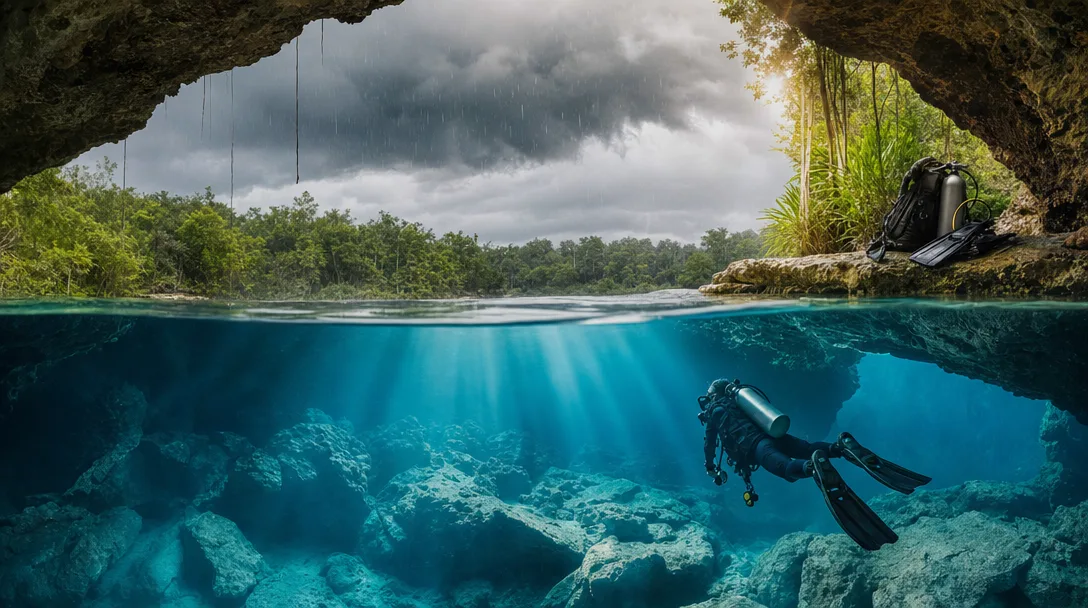
Cenote Diving After Rain: Visibility and Safety
Cenote diving after rain is usually fine: limestone filtration keeps visibility 30-60+ meters, while the main risks are lightning and slippery access.
Can you still go cenote diving after it rains?
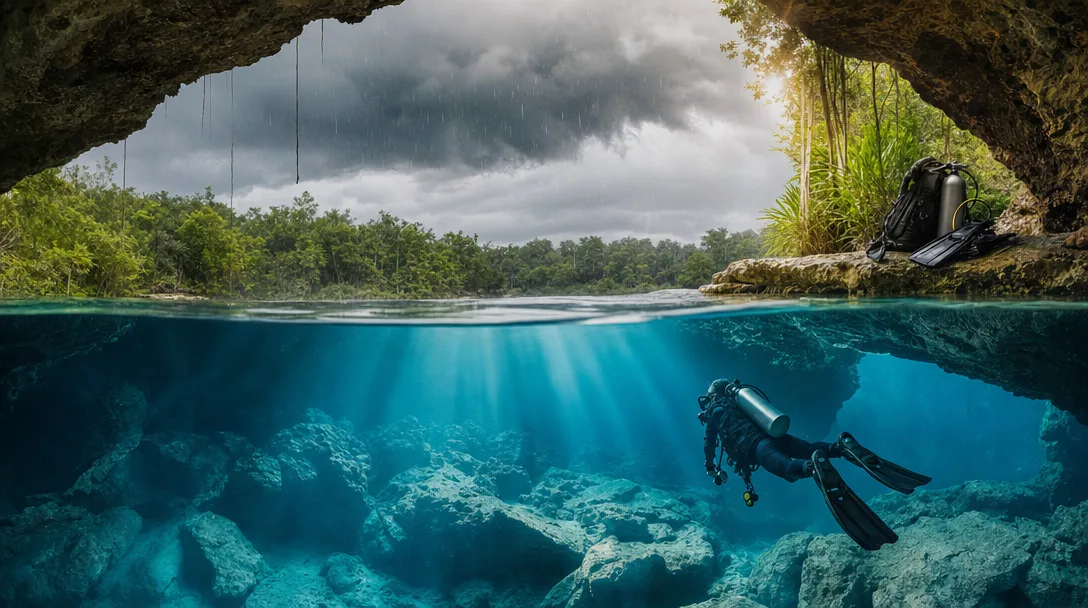
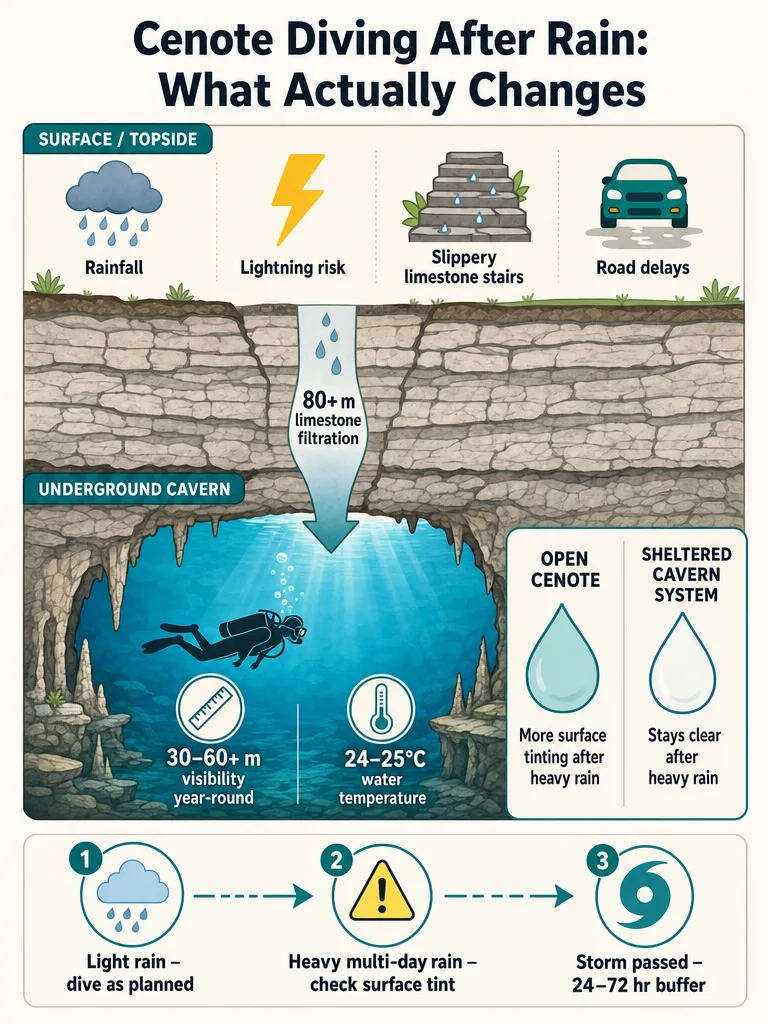
Cenote diving after rain is almost always still a good idea: cavern water comes from an underground aquifer filtered through more than 80 meters of limestone, so a storm rarely clouds the dive itself, according to Aqua Core Adventures. The real risk sits topside: lightning, slippery stairs, and muddy access roads.
Rain falling on the Quintana Roo jungle today doesn't reach a cenote today. It percolates through porous limestone over weeks to months before resurfacing, arriving filtered, cooled, and largely free of suspended sediment, Aqua Core Adventures explains. That's why a cavern dive during a downpour tends to look the same as it does on a dry, sunny afternoon.
What actually changes is the surface experience: whether the drive from your hotel takes longer, whether the stairs down to the water are wet, and whether a guide delays entry until a lightning cell passes. None of that is a reason to cancel a trip outright. Choose an operator who tracks conditions and adjusts the plan instead of running a fixed script regardless of weather.
Does rain affect cenote visibility underwater?
Rain does not meaningfully change the visibility inside a cenote's aquifer: Aqua Core Adventures measures cenote visibility as holding steady year-round at 30 to 60-plus meters, because limestone filters the water long before it reaches the cavern. A cenote itself is a natural sinkhole in the Yucatán's limestone bedrock, formed where a cave roof collapsed and exposed the aquifer below it. Dressel Divers goes further, reporting that visibility in some cenotes sometimes reaches 100 meters.
The exception is the top layer of water in open, shallow cenotes during extended heavy rain. The Cenote Guy notes that heavy rainfall can introduce runoff and sediment near the entrance of open cenotes, temporarily clouding that top layer. Aqua Core Adventures gets more specific: during the height of rainy season, the top 30 centimeters of water in some shallow cenotes can turn tea-colored, while clarity below that layer stays intact. Once a diver descends about a meter, Aqua Core Adventures says visibility typically returns to around 60 meters, and that haze sits in a thin surface skin rather than running through the body of the dive.
Divers worried about rainy-season visibility are usually picturing river-style flooding, but cenotes don't work that way. They're groundwater, not runoff channels, and the aquifer buffers nearly all of what falls from the sky above.
Are open cenotes worse than sheltered cenotes after heavy rain?
Open, ground-level cenotes feel rain sooner than sheltered cavern systems, because their exposed surface collects leaf litter, dirt, and runoff right where the water sits. Cavern systems with overhead rock cover, the type used for most guided recreational cenote dives, stay buffered from that surface effect almost entirely, according to Aqua Core Adventures.
The practical difference comes down to how much open sky sits above the water. A fully open cenote takes rain and sun directly on its surface, the way most open-air cenotes popular for snorkeling near Playa del Carmen do. A cavern-style system routes divers through rock-shielded galleries where surface weather has little to do with what a guide sees underwater.
| Cenote type | How rain-sensitive | Why |
|---|---|---|
| Open, ground-level | Surface layer can cloud after heavy, sustained rain | Open sky lets runoff, leaves, and sediment reach the water directly |
| Sheltered cavern system | Buffered from most surface runoff | Overhead rock limits how much rainwater and debris reach the dive zone |
Dressel Divers' operational rule explains why cavern dives hold up so well: cavern diving stays within 60 meters (200 feet) of a natural exit at all times, and Dressel Divers caps its own cenote dives at 14 meters depth. That distance and depth ceiling keeps a guided dive inside a buffered section of the aquifer, insulated from the conditions a storm actually touches at the surface.
None of this puts open cenotes off-limits after rain. Snorkeling in an open cenote right after a downpour can still be clear; it just carries a higher chance of a hazy top layer than a cavern dive does. If your itinerary includes both types, ask your guide which site to prioritize on a day with recent heavy rain, since conditions can vary from one cenote to the next even within the same region.
How long should you wait to dive a cenote after a storm?
Most rain requires no waiting at all; only severe storms and hurricanes call for a buffer, and that buffer is measured in hours, not days. Use a simple framework based on storm severity:
- Light to moderate rain, no thunder. Dive as planned. Aqua Core Adventures treats cenote visibility as unaffected by routine rain, since the aquifer filters the water before it reaches the cavern.
- Active lightning or thunder. Wait it out topside. Lightning is a surface hazard before and after a dive, not an underwater one, and most guides pause entries until a storm cell clears.
- Heavy, sustained rain over a cave or semi-open cenote. Give it roughly 24 hours. Rutopía's safety guidance recommends avoiding cave entry in the 24 hours after heavy rain, since water levels can rise quickly in cave and semi-open systems.
- Named storm or hurricane in the region. Check the National Hurricane Center's advisories, which Aqua Core Adventures recommends monitoring during Atlantic hurricane season, running June 1 through November 30. Cenotes sit inland and stay largely sheltered from storm surge, but roads, trees, and operator logistics take the real hit.
- Just after a hurricane passes. Plan for a 24 to 72 hour buffer. Aqua Core Adventures notes this window mainly covers clearing roads and debris rather than waiting out underwater turbidity, since the cavern clears faster than the surface does.
What changes topside after rain: stairs, roads, and pickup timing
The most common real-world impact of rain on a cenote dive day isn't underwater at all. It shows up in how you get to the site and how you get in the water. Four things shift most often:
- Wet limestone stairs and ladders. Rutopía's safety research flags cenote ladders and descents as the most dangerous part of the day even in dry weather; wet rock after rain raises that risk further. Water shoes or sandals with secured back straps handle this better than flip-flops.
- Muddy parking and access paths. Dirt lots and jungle paths around community-managed cenotes turn soft and slick after rain, adding a few extra minutes to the walk from the car to the water.
- Slower highway and jungle-road travel. Rain on the Cancún-to-Tulum corridor slows traffic and lengthens transfer times between your hotel and inland cenotes.
- Possible shift in pickup timing. Rain can slow transfers and shift pickup windows across the corridor, since road travel is the variable most affected by a storm. Understanding how hotel pickup works for diving from Cancún to Tulum helps set realistic expectations for timing on a wet morning.
None of these changes cancel a dive day. They change how early you should expect pickup and how carefully you should move once you're on-site, especially on the stairs leading down to the water.
How guides decide whether to switch cenotes, delay, or go as planned
Experienced guides treat rain as a routing decision, not a cancellation trigger. The Cenote Guy notes that during rainy periods, operators often adjust which cenote they use rather than scrapping the day, since some sites handle rain better than others. The decision generally follows this order:
- Check what already fell and where. A guide compares recent rainfall against which cenotes on the route are open versus sheltered cavern systems, since open sites show surface effects first.
- Default to the sheltered option. If a planned stop is an open cenote and conditions look marginal, a guide often swaps it for a cavern-style site that stays buffered from surface runoff.
- Keep the day's itinerary intact where possible. A single-site swap is usually enough to keep the rest of a multi-stop day on schedule. For a sense of how a typical day is structured, see how many cenote dives you can fit into one day.
- Delay only for lightning or access hazards. A short hold at the surface, rather than a cancellation, is the usual response to a passing storm cell.
- Reserve full cancellations for the rare cases. Full-day cancellations are uncommon outside hurricane season, Aqua Core Adventures notes, and even then the main driver is road access and debris clearance rather than lost underwater visibility.
Where you're based shapes how many routing options a guide has on a rainy morning. See diving from Tulum or Playa del Carmen: which is easier for how your choice of base affects logistics more broadly.
What to pack and wear for rainy-season cenote diving
Rainy-season cenote diving calls for the same core gear as any other month, plus a couple of small additions for wet footing and shifting air temperature. Cenote water holds steady at 24-25°C year-round, according to The Cenote Guy and Aqua Core Adventures, so exposure protection doesn't change with the season; what changes is how you handle the walk to and from the water.
- A 5mm full wetsuit. Aqua Core Adventures recommends this thickness year-round, since cenote water temperature doesn't shift with the rain.
- Water shoes or sandals with secured back straps. Rutopía's safety guidance recommends these over flip-flops, since wet limestone stairs and ladders are a real fall risk, rain or not.
- A dry bag or trash bag for your day pack. Rainy-season downpours are often brief but heavy; a simple liner keeps a towel and phone dry between stops.
- A light rain layer for the drive. You won't need it in the water, but it helps on muddy parking-lot walks and surface intervals.
- A quick gear check with your operator. What's provided versus what you should bring yourself varies by trip. Confirm suit thickness and included equipment before you book; for a general rundown of what's typically provided on guided cenote dives, see do you need your own gear for cenote diving in Mexico.
Pack light, move slowly on wet stone, and let the operator handle the rest. Rainy-season cenote diving rewards preparation more than it punishes bad weather.
Frequently asked questions
Is rainy season a bad time to visit the Riviera Maya for cenote diving?
Rainy season, roughly June through November, is not a bad time for cenote diving because underwater visibility stays steady at 30 to 60-plus meters regardless of rainfall. Aqua Core Adventures flags May, late September, and early October as sweet-spot months with lighter crowds and manageable rain, while November through April stays driest and busiest with cenotes like Dos Ojos drawing lines by 8 a.m. Hurricane season runs June 1 through November 30, so check National Hurricane Center advisories if a named storm is forecast.
Do cenotes flood like rivers when it rains heavily?
No, cenotes do not flood like surface rivers because they're fed by groundwater, not runoff channels. Rain falling on the Quintana Roo jungle takes weeks to months to percolate through more than 80 meters of limestone before resurfacing in a cenote, arriving filtered and free of suspended sediment, according to Aqua Core Adventures. That slow aquifer buffer is why a cavern dive during a tropical storm looks the same as one on a dry day, unlike a river that clouds or rises within hours.
Does rain change the water temperature inside a cenote?
No, cenote water holds steady at 24 to 25°C year-round regardless of rain or season, according to both The Cenote Guy and Aqua Core Adventures. The temperature comes from the aquifer itself, not surface weather, so a downpour the week before a dive has no measurable effect on how the water feels. Pack a 5mm full wetsuit for any month, rainy season included, since exposure protection needs don't shift with the rain.
Can beginners or first-time snorkelers still do a cenote tour if it's raining?
Yes, beginners and snorkelers can usually still go, since most rain only affects the thin surface layer of open, ground-level cenotes rather than the whole site. Guides commonly route a day toward a sheltered cavern-style cenote when conditions look marginal for an open one, keeping the itinerary intact rather than canceling. Message Seth Dive with your dates, hotel, and experience level, and he'll recommend the right cenote for a wet-weather day rather than running a fixed script.
What happens to a cenote diving trip if a hurricane is forecast?
Cenotes themselves stay largely safe during a hurricane, since they sit inland and are sheltered from storm surge; the real disruption comes from road access and debris after the storm, according to Aqua Core Adventures. Hurricane season runs June 1 through November 30, so check National Hurricane Center advisories for named storms during that window. Plan for a 24 to 72 hour buffer after a hurricane passes mainly for clearing roads, not for underwater turbidity, since the cavern clears faster than the surface does.
Will rain delay my hotel pickup for a cenote tour?
Rain can push pickup times later, since the Cancún-to-Tulum corridor is the part of the trip most affected by weather, not the dive itself. Slower highway traffic and muddy access roads near inland cenotes add minutes to transfer times on a wet morning. Seth Dive offers free hotel pickup across Cancún, Playa del Carmen, and Tulum and adjusts timing around road conditions rather than running a fixed schedule, so check in with your guide the morning of a storm for an updated window.