Should you do a refresher or go straight to a cenote after a long break?
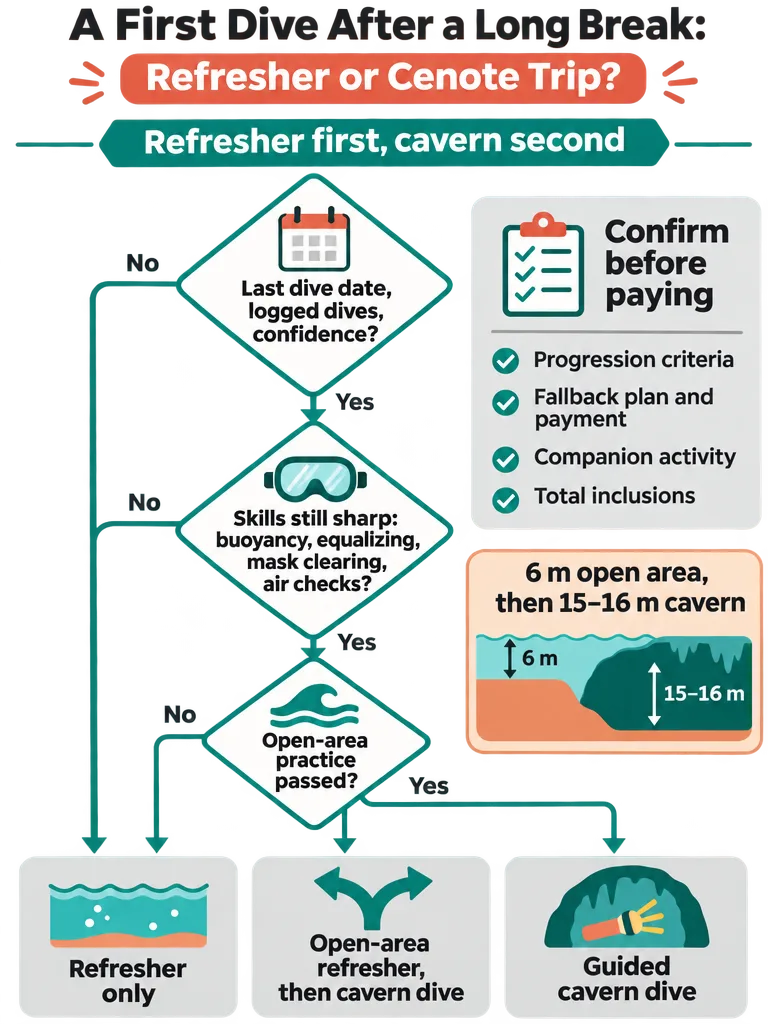
For cenote diving in the Riviera Maya, a first dive after a long break is rarely a refresher-or-cenote choice. If skills feel rusty, practice them in shallow or open water first, then decide on the cavern. Xico Dive Center advises certified but rusty divers to do a refresher or an easier reef dive first.
How much practice you need depends on retained skills, confidence, dive experience, and the environment you plan to dive, not on the calendar alone. Some operators publish combined same-day programs. Triton Diving describes skills practice in an open-air cenote area followed by a cavern dive, and Maya Blue Dive Center and Agua Clara list refresher-and-cenote programs too. Scuba Libre says certified divers can usually dive after a long gap, but suggests a scuba review first if it has been months or years.
Agency timing rules from PADI or DAN are not covered in the material behind this article. Operator guidance is not agency policy, so the guide's assessment of you decides the plan.
How much time off means you need a scuba refresher?
No source in this research sets a universal cutoff for when a certified diver needs a scuba refresher. Diving Cenotes Playa describes the assessment as a mix of previous experience, time away, the types of dives done before, and present confidence. Scuba Libre says that if it has been "months or years," a scuba review may be the better first choice.
Elapsed time alone does not decide the question. A scuba review, as Scuba Libre defines it, is for certified divers who have not dived for a while and want to refresh knowledge and skills before regular dives.
República Diving notes that a scuba certification never expires. After inactivity, though, you need to brush up on basic skills and safety procedures and get comfortable in the water again, and the operator recommends the PADI ReActivate refresh program.
Treat any interval an operator quotes as that operator's suggestion. The sources here do not include agency guidance on timing, so the instructor's assessment of your logbook and skills is the practical test.
What skills do you need before your first cenote dive?
Before a first cenote dive, certified divers need control of the basics: equalizing, calm breathing, mask clearing, air checks, following a guide closely, spacing from other divers, neutral buoyancy, and controlled fin kicks that don't stir silt. Xico Dive Center says buoyancy is usually the most important of these.
Diving Cenotes Playa's refresher practice list works as a second self-check:
- Equipment assembly and buddy checks
- Mask clearing
- Regulator recovery and clearing
- Ascent and descent control
- Inflator use
- Buoyancy, body position, and finning
Run through both lists and mark anything that feels rusty. Tell the instructor about every item you marked, along with any concern about overhead spaces, and ask them to assess you in an open area before a cavern dive is considered. For a picture of the full day, read what a first cenote dive near Tulum is actually like.
Should you do an easier reef dive before the cenote?
An easier reef dive can be a gentler re-entry than a cenote after a long break. Scuba Libre recommends afternoon reef dives for newly certified divers or anyone who has not dived for a while, and morning dives for divers with solid logbooks and recent experience. Xico Dive Center also suggests an easier reef dive first for rusty divers.
The trade-off is conditions. Scuba Libre notes that dive sites can depend on weather, sea conditions, certification level, and safety decisions on the day. Xico describes cenote diving as having no waves and usually no current. Bubbles Diving says cenote water stays around 24 to 25 °C year-round.
A reef dive does not replace skills practice if several skills feel rusty. Ask the guide for sea and weather conditions on the specific day you plan to dive, since conditions change from day to day.
Refresher only, refresher plus cenote, or straight to the cavern: which fits?
A separate refresher is skills practice only, a refresher-plus-cenote program practices skills in an open cenote area and then adds a cavern dive, and a straight guided cavern dive skips the practice. Your last dive date, logged dives, and confidence point to a provisional choice, and the instructor's assessment confirms it. Each figure below comes from that operator's own undated listing.
| Option | What happens | Who it suits | What to confirm |
|---|---|---|---|
| Separate refresher | Skills review in shallow or open water | Long gap, several rusty skills | Duration, price, location |
| Refresher in an open cenote area, then cavern | Triton Diving lists a 6 m maximum open area, then a 15 to 16 m cavern, with a maximum of 4 divers per guide | Rusty but certified divers who want a cenote the same day | What the instructor must see before the cavern |
| Combined program with prerequisites | Maya Blue Dive Center requires Open Water certification, at least 15 logged dives, and minimum age 15 | Divers who meet the listed prerequisites | Whether your logbook qualifies |
| Straight guided cavern dive | Briefing, then a planned cavern route | Recent, confident divers | Last dive date, certification level, guide's decision |
A recreational cavern dive stays within defined limits, follows a planned route, and keeps natural light visible. Xico says full cave diving goes beyond that and requires specialized training, equipment, and procedures.
The material here does not establish whether Angelita or The Pit suits a diver after a long break. For depth and certification context, see which certifications let you dive The Pit.
What if your partner or family isn't certified: can they join?
Non-certified companions can sometimes join a cenote day as snorkelers or through an introductory-diving program, but it depends on the trip, so confirm in advance. Scuba Libre says companions can sometimes join and that arrangements vary by trip. República Diving asks to be told ahead of time so it can combine snorkeling and diving or arrange Discover Scuba Diving.
Snorkeling needs no certification. Seth Dive Mexico lists private cenote snorkeling in Xcaret with a private guide, snorkeling gear, entrance fees, and free hotel pickup and drop-off listed from Cancún to Tulum. Confirm that pickup for your own booking.
Discover Scuba Diving is a separate introductory program, not a certified cavern itinerary. Read whether beginners can do Discover Scuba in a cenote for the differences. The material here does not confirm exact introductory routes or how a refresher can be combined with them.
A hypothetical example, not a customer result: a certified diver last dived years ago and travels with a partner who isn't certified. The diver lists retained skills and logged dives and flags a rusty mask clear. The pair asks the guide for an open-area assessment first, with the partner snorkeling nearby, and pre-agrees that if the instructor wants more practice, the day stays a refresher and the cavern waits.
Before booking, confirm shared transport and timing, and ask who supervises each person while the other is underwater.
What should you ask the guide before paying for a refresher or cenote dive?
Before paying, ask about prerequisites and proof to bring, what the instructor must see before moving from an open area to a cavern, what happens to the itinerary and payment if you need more practice or decline the cavern, group size and guide ratio, and a written total covering instructor, gear, computer, lights, entrance, food, and pickup from your exact hotel.
- Prerequisites and proof. Scuba Libre asks for a physical or digital certification card plus any recent dive information. Operators differ on paperwork: Maya Blue lists medical-statement conditions and a signed release, and República Diving requires a medical questionnaire.
- Progression criteria. What must the instructor see in the open area before moving to the cavern?
- Fallback. If you need more practice or decline the cavern, what happens to the itinerary and the payment? The published combined programs reviewed here don't explain this, so ask.
- Group size and ratio. How many divers per guide?
- Written total. Does it cover instructor, gear, computer, lights, entrance, food, and pickup from your exact hotel? Confirm free pickup for your booking rather than assuming it.
Inclusions vary widely. Triton Diving, Agua Clara, and Maya Blue Dive Center each publish an undated listing, and each detail below applies only to that operator, not to any other:
| Operator | Advertised amount | Inclusions noted |
|---|---|---|
| Triton Diving | 3,800 MXN per person | Equipment, lights, transport, entrance, snacks |
| Agua Clara | 3,300 MXN for one refresh dive and one cavern dive, plus 700 MXN entrance fees | Entrance fees paid in cash at the cenote |
| Maya Blue Dive Center | Not compared here | Excludes entrance fees, full equipment rental, and a dive computer |
For packing, see what to pack for a cenote dive day. For travel time and costs, see cenote diving from Cancun.
What should you send a dive guide to get a recommendation that fits?
A useful message gives the guide your travel dates, hotel or pickup area, each person's certification status, the certified diver's level, last dive date and logged dives, any concerns about overhead spaces, ears, or buoyancy, and the activity you want. Copy this worksheet and fill it in:
- Travel dates: ___
- Hotel or pickup area: ___
- Certified divers (level, last dive date, logged dives): ___
- Non-certified companions: ___
- Concerns (overhead spaces, ears, buoyancy): ___
- Activity wanted (refresher, cenote dive, snorkeling, or a mix): ___
Sending a message is not a booking. The guide confirms availability and price, and the plan can change once they read your experience level.
Sources
- First Time Cenote Diving: What to Expect | Xico Dive Centerxicodivecenter.com
- scubalibre.com.mxscubalibre.com.mx
- republicadiving.comrepublicadiving.com
- bubbles-diving.combubbles-diving.com