Can One Diver and One Snorkeler Share the Same Riviera Maya Cenote Day?
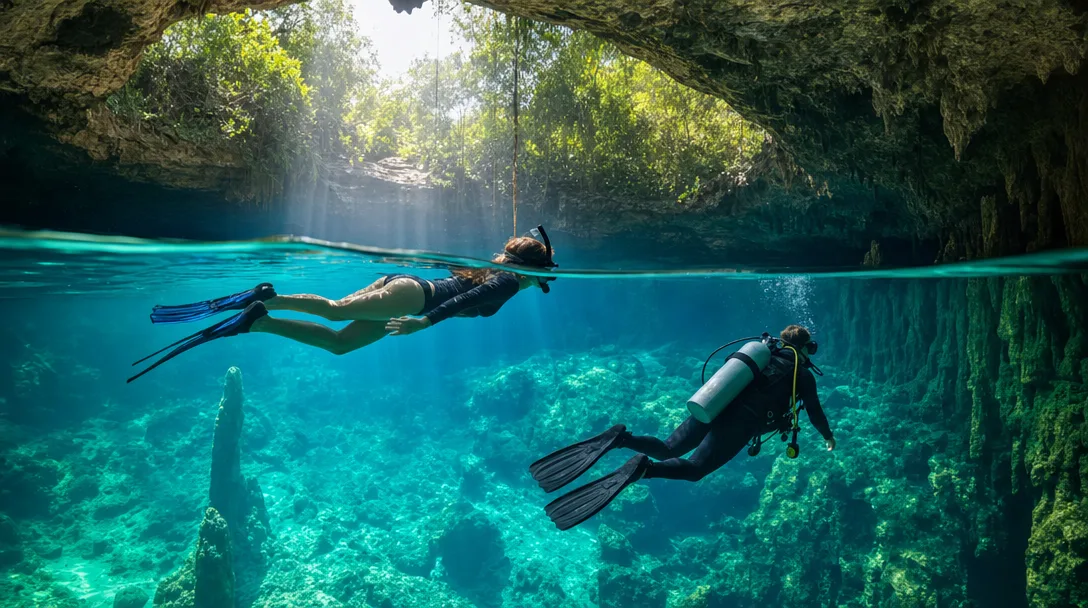
Yes, one diver and one snorkeler can share the same Riviera Maya cenote day. The usual setup has them riding to the same cenote together, booking two separate activities, and spending the day at the same site: the diver follows a guided cavern route on scuba while the snorkeler stays in the cenote's open-water area with mask, fins, and a flotation vest.
They share transport, the cenote itself, and breaks like lunch, but they don't necessarily follow the same underwater route, according to a guide on whether non-divers can join a cenote day with certified divers. Which cenote you pick changes how well that split works, because some sites have a wide open-water pool right next to the cavern entrance while others drop almost straight down, leaving little room for a non-diver to actually enjoy being in the water.
What Does a Mixed Diver-Snorkeler Day Actually Look Like?
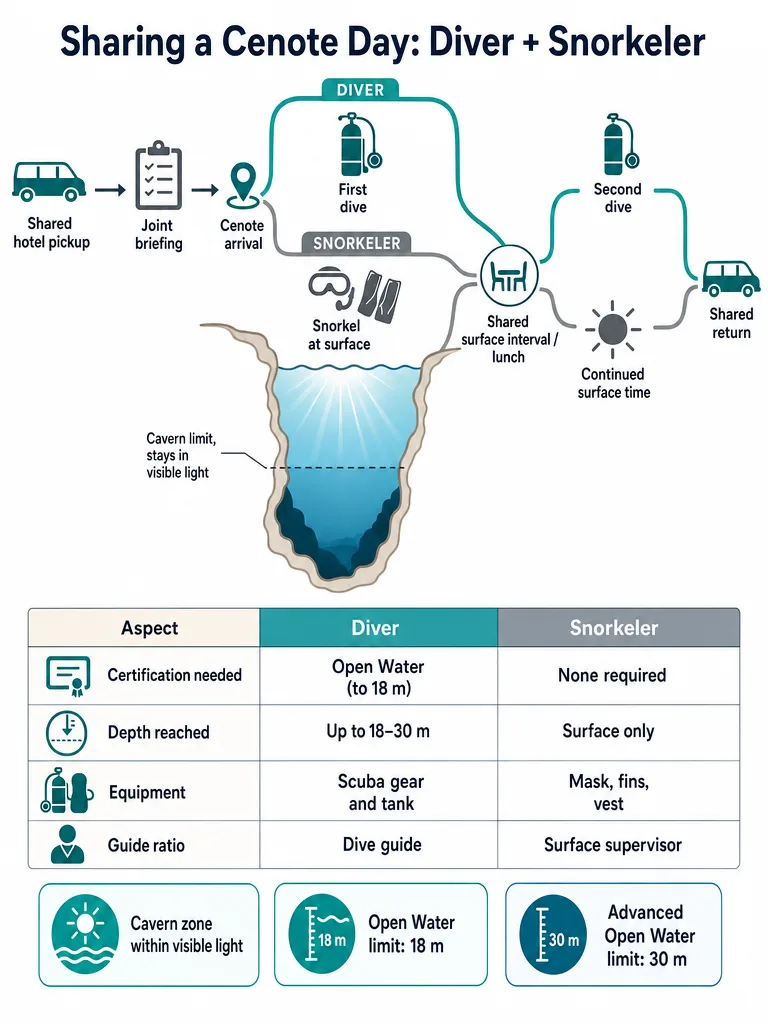
A mixed day is built around the diver's normal two-dive structure, with the snorkeler sharing the same cenote and the same published trip window rather than a separate itinerary. Riviera Maya cenote days are typically built around two dives for the certified diver, per a guide on how many cenote dives you can do in one day, and operators that sell both roles together keep diver and snorkeler on one listed time slot.
Cancun Diving, for example, publishes a 2-tank cenote diving trip and a cenote snorkeling option on the identical day-trip window, running from 7:30 AM to roughly 4:30 to 5:00 PM. That shared-schedule structure is what makes a same-day booking possible at all: instead of coordinating two separate trips, the diver and snorkeler book into one listed day.
A general shape for that kind of day looks like this:
- Hotel pickup, on the published start time for the trip.
- Site briefing, where the guide splits attention between scuba setup for the diver and mask-and-fins fitting for the snorkeler.
- The diver's first dive, while the snorkeler is in or around the water at the same cenote.
- A surface interval, which also works as a shared break for both people.
- The diver's second dive, continuing the normal two-tank structure; some operators pair a deeper first dive with a calmer second cenote. Always Diving, for instance, pairs Angelita with a shallower second tank at Car Wash or Casa Cenote to round out the day.
- Return transport, on the same overall timeline published for the trip.
Exactly when the snorkeler enters the water relative to each dive varies by operator and cenote, so confirm that sequence with your own guide rather than assuming it matches another company's listing.
Which Cenotes Work Best for a Diver and a Snorkeler Together?
Dos Ojos and Casa Cenote fit a mixed pair better than Angelita or The Pit, mostly because of how much open surface area each site gives a non-diver, not just the certification rule attached to it. A comparison of cenote certification and depth requirements lists Dos Ojos at a 10 m maximum depth suited to Open Water divers, while Angelita and The Pit sit at a 40 m maximum recreational depth that calls for Advanced Open Water, based on figures compiled from Aquacore Adventures in a guide to choosing between Angelita, The Pit, and Dos Ojos. In practice, Dos Ojos and Casa Cenote give the snorkeler an actual place to be rather than a boat to wait beside, while Angelita and The Pit are built around the diver's experience first.
| Cenote | Certification needed | Max depth | Snorkeler fit |
|---|---|---|---|
| Dos Ojos | Open Water | 10 m | Strong: twin pools, wide calm surface area |
| Casa Cenote | Open Water | 9 m | Strong: mangrove shallows, easy relaxed snorkeling |
| Angelita / The Pit | Advanced Open Water | 30 to 40 m | Weak: narrow sinkhole mouth, deep drop-off, little open surface to snorkel |
Those depth and visibility figures come from a few different operators, and they don't all match. Aquacore Adventures' numbers, as relayed in that comparison guide, put Dos Ojos visibility at 60 m or more. The Cenote Guy lists Casa Cenote at 9 m deep with a 50-minute dive time. Always Diving puts Angelita's full sinkhole at 61 m with the working dive sitting closer to 30 m, while the comparison guide above lists a 40 m recreational cap for both Angelita and The Pit. Route and depth rules differ by operator and by the exact plan booked, so confirm the specific depth and route with your guide before paying rather than assuming one number applies everywhere.
Does the Diver Need Open Water or Advanced Open Water for This Trip?
PADI Open Water certification covers the cavern zone to about 18 meters (60 feet), while Advanced Open Water extends recreational cenote diving to about 30 meters (100 feet). Cavern diving stays within sight of daylight at all times; true cave diving leaves that light zone entirely and needs separate Full Cave training, the kind used in systems like Sac Actun.
Where the line falls at a specific cenote depends on who you ask. A guide to choosing between Angelita, The Pit, and Dos Ojos lists both deeper sites as Advanced Open Water cavern dives capped at a 40 m recreational depth. Aquacore Adventures, by contrast, treats some deeper routes at The Pit as requiring full cave training rather than a cavern-level Advanced Open Water dive.
"Cavern diving means not straying out of the range of visible light from the surface, and not going further than 60m into the overhead environment." (Dive Magazine)
Dos Ojos and Casa Cenote sit well inside the shallower Open Water range across the sources above. If the diver in your pair holds Open Water only, the deeper sites are off the table for this trip regardless of which classification applies.
What's Included for the Diver vs the Snorkeler?
A diver's package on a shared cenote day usually includes full scuba gear and tanks, while a snorkeler's package covers mask, fins, and a flotation vest instead, with both roles typically sharing transport and a lunch window. Always Diving's Angelita package, for one, lists BCD, regulator, mask, fins, wetsuit, and weights as included for the diver, alongside roundtrip transport and meals for the group.
| Inclusion | Diver | Snorkeler |
|---|---|---|
| Underwater gear | Full scuba set: BCD, regulator, wetsuit, weights, tank(s), per Always Diving's Angelita package | Mask, fins, and a flotation vest are standard for cenote snorkeling; exact gear lists vary by operator |
| Guide ratio | PADI Cavern Diver training caps certified cavern guides at 3:1, with a 4:1 hard ceiling | Supervision ratio depends on the operator; ask directly rather than assuming it matches the diver's ratio |
| Entrance fees | Often billed separately in cash; The Cenote Guy lists $700 MXN per person for its Casa Cenote and Angelita day | Entrance fees are typically charged per person at the cenote gate, whether you dive or snorkel |
| Transport & lunch | Roundtrip hotel transport and meals included on Always Diving's full-day Angelita package | Shared-day listings like Cancun Diving's publish one transport window covering both roles |
Camera fees are another line item worth asking about up front: Scuba Freedom notes these run 250 to 1,000 pesos depending on the cenote, and they're rarely bundled into the base price. For a closer look at how private-day pricing bundles some items and bills others separately, see what's actually included in a private cenote diving quote.
Should You Book Separate Diver and Snorkeler Seats or a Private Custom Day?
Shared diver-snorkeler cenote trips are usually sold as two separate priced seats on one public schedule, not a single combined product. Cancun Diving, for instance, lists its 2-tank cenote dive at $235 USD per diver and a cenote snorkeling option at $135 USD, both running the same published day from about 7:30 AM to 4:30 or 5:00 PM.
That fixed-menu format works fine when your cenote choice and timing already match what's published. It gets awkward when they don't: maybe the diver wants Dos Ojos but the public snorkel slot that day runs at Casa Cenote, or your hotel sits outside the standard pickup zone. A private custom day skips the fixed menu and lets a couple or family choose the cenote, the pace, and the pickup time together. Scuba Freedom's pricing notes list private tour requests starting from an extra $200 USD over the standard group rate, which gives a rough sense of what that flexibility costs on top of a shared trip.
Telling a guide your travel dates, hotel name, and each person's certification level up front is what turns a generic public listing into a day actually built around your pair, rather than fitting both of you into whatever a large group operator already has on a standard schedule. Operators that run private custom cenote days, including Seth Dive Mexico, typically ask for exactly that information before confirming a plan. A fuller breakdown of that trade-off is in a comparison of private versus group dive tours in the Riviera Maya.
What Should You Ask the Guide Before You Pay?
A short pre-payment checklist catches the mismatches that most often derail this exact scenario, mostly around certification proof, recent dive history, and pickup coverage. These are five questions worth sending before any deposit goes out:
- Certification proof. Confirm whether the chosen cenote needs Open Water or Advanced Open Water, and have the diver's card ready to send.
- Recent dive history. Some operators require a dive within the last 6 to 12 months before booking deeper sites like Angelita, per Always Diving, while The Cenote Guy asks for one within the past year. If the diver hasn't been underwater recently, say so before paying, not after arriving.
- Hotel pickup zone. Confirm your exact hotel or Airbnb falls inside the free pickup radius; pickup windows commonly shift by zone, with earlier departures from Cancun and later ones closer to the cenotes.
- Cenote and route fit for both people. Ask directly whether the snorkeler's area is open water next to the cavern entrance or a separate, far-off pool.
- Snorkeler group size and supervision. Ask how many snorkelers share one guide. Maya Blue Dive Center, for comparison, runs its snorkel-only tours at 2 to 6 people per group.
Age and health questions belong on this list too. Scuba Freedom's booking notes require divers 60 and older to submit a doctor's approval form, so it's worth confirming medical requirements alongside certification. A guide on whether non-divers can join a certified diver's cenote day covers how to ask these questions without feeling like an interrogation.
What If the Snorkeler Is a Nervous Swimmer or Has Never Snorkeled Before?
Whether a nervous swimmer or first-time snorkeler can join depends on the operator's own rules, how comfortable that person is in open water, and what the guide sees on the day, not a fixed yes-or-no standard. Operators that run cenote snorkeling for non-diving companions, such as Cancun Diving's snorkeling option, build it as a guided activity using a flotation vest rather than a strength-based swim test, but exact comfort requirements and age minimums vary by company.
This is a different product from Discover Scuba Diving, PADI's supervised introductory program that lets a non-certified beginner breathe underwater on tanks with an instructor at close range. A nervous swimmer who wants to try breathing underwater rather than just floating on the surface should ask about Discover Scuba separately; it isn't automatically part of a snorkel-only booking. Being upfront about swimming comfort and water confidence when you contact a guide lets them match the pace and the cenote to the actual person getting in the water, not just assume the diver's plan works for everyone.