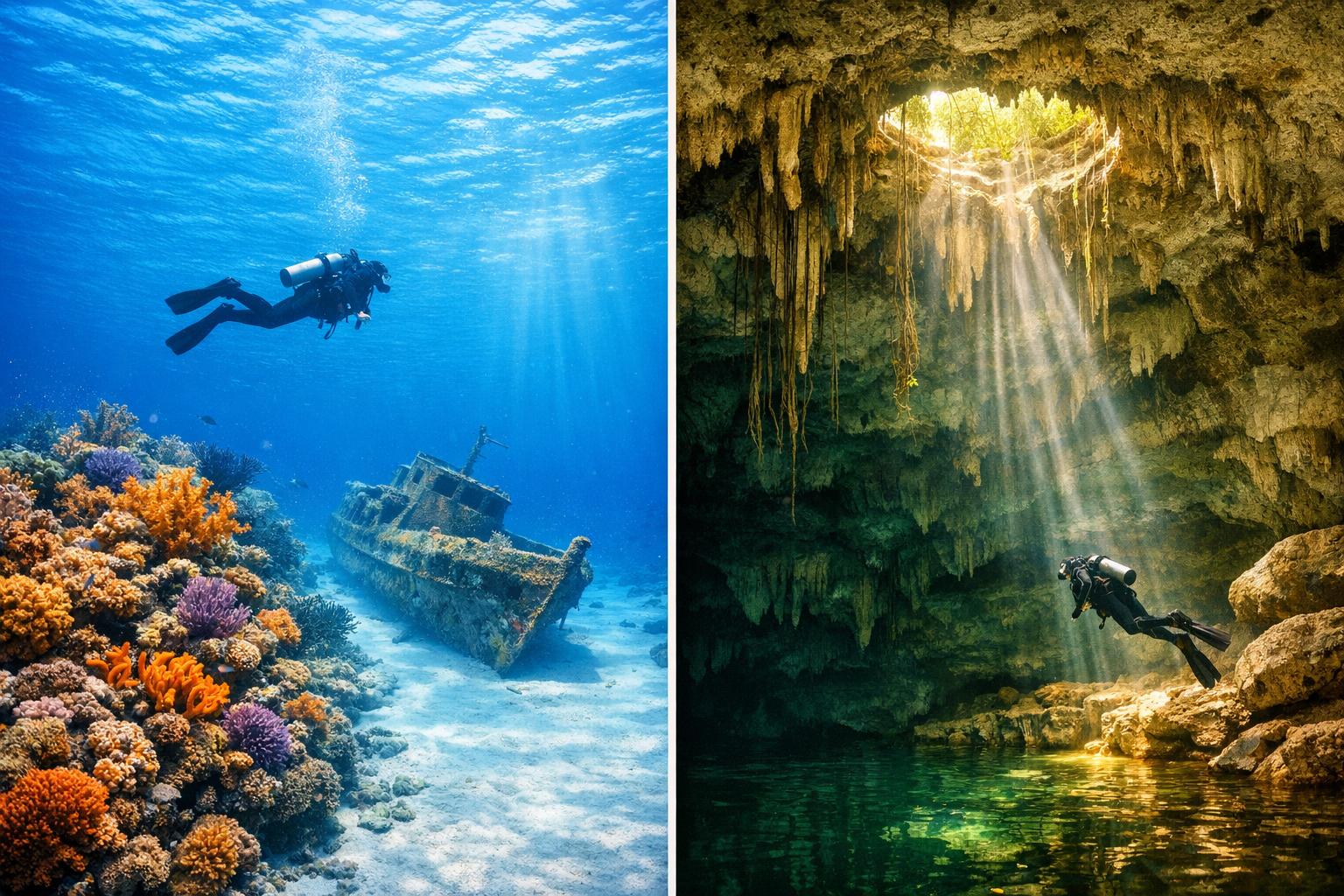
Choosing between Cancún and Tulum depends on your diving goals and travel preferences.
- Cancún is ideal for reef and wreck diving, with vibrant nightlife and all-inclusive resorts. It offers easy access to the Museo Subacuático de Arte (MUSA) and whale shark tours (May–November). However, cenote diving requires a 1.5–2-hour trip.
- Tulum is perfect for cenote enthusiasts, with over 50 cenotes nearby, including Gran Cenote and Dos Ojos. It has a relaxed, bohemian atmosphere with eco-lodges and jungle settings. Ocean diving is limited compared to Cancún.
Quick Comparison
| Feature | Cancún | Tulum |
|---|---|---|
| Diving Focus | Reefs, wrecks, MUSA, whale sharks | Cenotes (Gran Cenote, Dos Ojos) |
| Vibe | Party, resorts, nightlife | Relaxed, bohemian, eco-lodges |
| Beach Conditions | Wide, resort-maintained, less sargassum | Small coves, natural, sargassum issues |
| Cenote Access | 1.5–2 hours away | 10–30 minutes away |
| Accommodation Cost | $30–$400 (resorts, budget options) | $40–$800 (eco-lodges, dive lodges) |
| Airport Access | 30 min from Cancún Intl. Airport (CUN) | 1.5–2 hrs from CUN or Tulum Airport |
For reef diving, choose Cancún. For cenotes, Tulum is unbeatable. Both offer unique experiences, but your choice depends on what kind of underwater adventure you’re after.
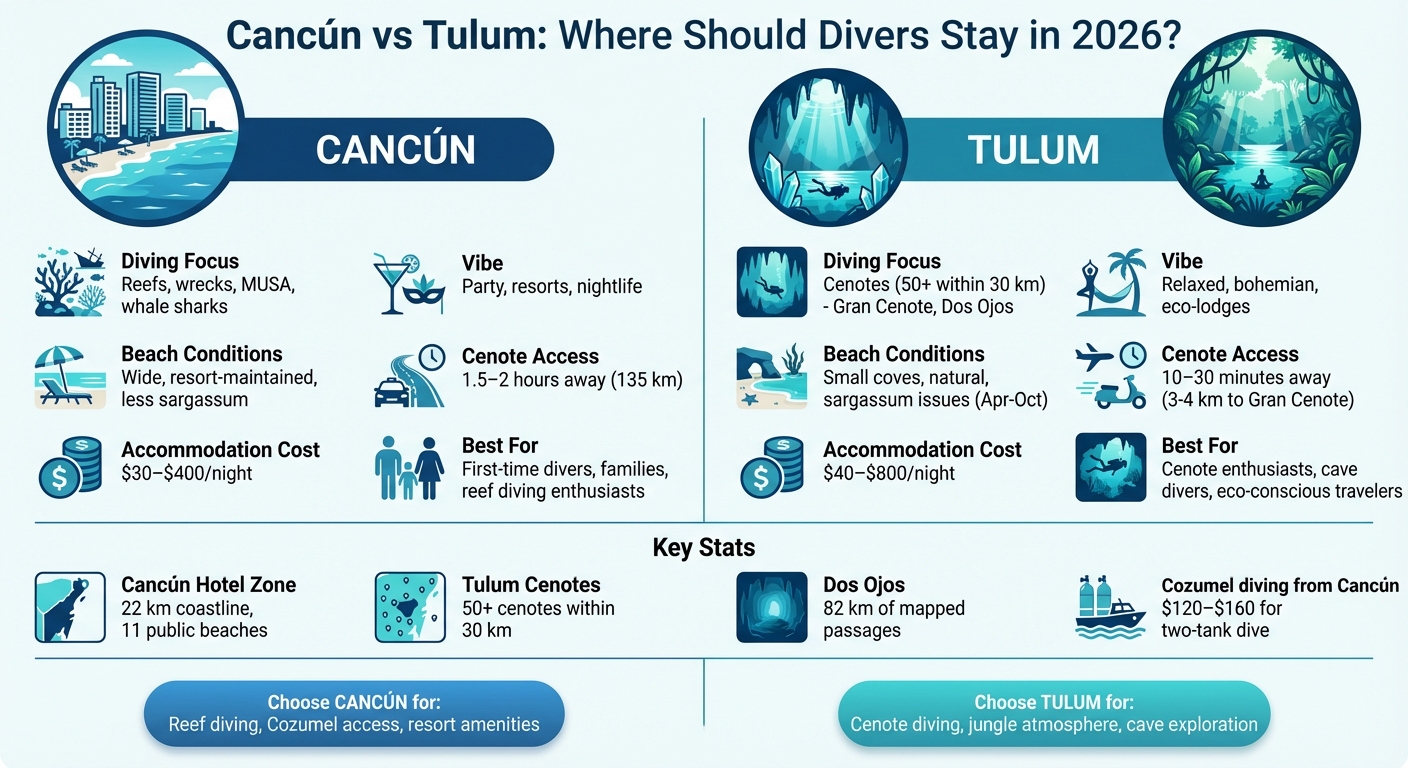
Cancún vs Tulum Diving Comparison 2026: Key Differences
Beaches and Water Access
Cancún: Wide Beaches and Resort Facilities
Cancún's Hotel Zone stretches along a 22 km barrier island, bordered by the Caribbean Sea on one side and the Nichupté Lagoon on the other [1]. This area boasts approximately 21 km of coastline with 11 public beaches. From the vibrant blue waters of Playa Delfines - where dolphins are often spotted - to Playa Chac Mool, a diver’s favorite for its direct ocean access, Cancún offers a variety of beach experiences [2].
The north-facing area near Punta Cancún stands out with its calm, protected waters, thanks to the natural barrier of Isla Mujeres. This makes it a perfect spot for beginner divers and those new to snorkeling [1]. Resorts in the area maintain their wide, pristine beaches daily, removing sargassum and debris. Plus, many resorts offer direct boat access, making trips to nearby reefs or the underwater museum easy and convenient for visitors [2][3].
While Cancún impresses with its expansive, resort-serviced beaches, Tulum offers a completely different coastal experience.
Tulum: Small Coves and Natural Settings
Tulum’s beaches provide a more intimate and natural vibe compared to Cancún’s sprawling, resort-driven shores. Here, you’ll find small coves surrounded by lush jungle and rustic beach clubs, offering a quieter, more secluded atmosphere [1][2].
Facing southeast into the main Atlantic current, Tulum's beaches often deal with high levels of sargassum from April to October, with seaweed sometimes piling up to chest-deep levels. This makes beach conditions unpredictable during these months [1]. Additionally, access to many of Tulum’s southern beaches can be limited. Visitors often need to stay at a beachfront hotel or pay a daily fee of $50–$100 USD to access beach clubs [2].
For divers, Tulum shines in its proximity to cenotes. Gran Cenote, located just 3 km away, is easily accessible by bike for around 300 MXN. The area’s rustic, bohemian charm appeals to adventure seekers who value cenote diving and a tranquil, jungle-backed setting over the polished amenities of resort beaches [1].
sbb-itb-8d6faf7
Cenote Diving Access from Each Location
Cancún: Day Trips to Cenote Areas
Cancún is about 135 km from the main cenote zones, which translates to a drive of roughly 1.5–2 hours to popular spots like Gran Cenote and Dos Ojos [9][3]. Because of the distance, cenote diving from Cancún typically requires a full-day commitment.
Many divers in Cancún choose organized tours that include round-trip transport in private vans. Another option is using ADO bus routes heading south. For a quicker journey, the Maya Train offers a 90-minute ride from Cancún Airport to Tulum for 180 MXN, though you’ll need additional transport to reach individual cenotes once you arrive [1]. If your destination is a cenote further inland, like Suytun Cenote near Valladolid, expect a drive of about 2 hours and 10 minutes from Cancún [5].
Compared to Tulum, Cancún requires more travel time to reach cenotes, making Tulum a more convenient base for divers.
Tulum: Close Proximity to Cenote Sites
Tulum is often called the "cenote diving capital of the world" - and for good reason. More than 50 cenotes are located within just 30 km of the town [6]. Gran Cenote, for instance, is only 4 km away (a quick 10–15-minute trip), while Cenote Calavera is even closer at 3 km [6][7]. Dos Ojos, one of the largest underwater cave systems with over 82 km of mapped passages, is just a 25-minute drive [6][8].
"Tulum holds a special place in the hearts of divers everywhere as the cenote diving capital of the world."
- Ed and Jenn, Co-Founders, Coleman Concierge [4]
Tulum’s close proximity to cenotes offers unmatched convenience. Renting a bike for 200–300 MXN per day is a popular and easy way to visit nearby cenotes like Gran Cenote or Cenote Calavera. Dive shops in the town center often serve as meeting points, with short van rides taking divers deeper into the jungle to explore more remote cenotes [4]. For a quieter experience, plan your visit to popular cenotes before 10:00 AM or after 3:00 PM to avoid the larger crowds traveling from Cancún or Playa del Carmen [6].
Cancun Vs. Tulum, Which Should You Choose?
Ocean Diving and Marine Life in 2026
Beyond the allure of beaches and cenotes, ocean diving offers a deeper way to connect with each destination's underwater world.
Cancún: Reef Diving and Cozumel Access
Cancún’s reefs are perfect for beginners, though they come with flatter profiles and less dense coral formations [10]. The marine life here is rated from low to moderate, with sightings of tropical reef fish and creatures living around artificial structures [10].
One standout feature is MUSA, an underwater museum where submerged sculptures double as artificial reefs [10].
"Cancun is primarily a resort city, where scuba diving exists as an add-on activity rather than the central attraction."
- Sunset Cozumel [10]
However, Cancún’s proximity to Cozumel makes it a gateway to even more impressive diving. A two-tank dive in Cozumel costs around $120–$160 and offers breathtaking coral walls, drift diving, visibility of 30–40 meters, and an abundance of marine life [10]. Cozumel is also the only place where you might spot the splendid toadfish, a species found almost exclusively in this region [10].
On the other hand, Tulum’s ocean diving focuses less on reefs and more on its world-famous cenotes.
Tulum: Limited Reefs but Exceptional Cenote Diving
Situated along the Mesoamerican Barrier Reef, Tulum offers tranquil, warm dive sites like "Cuevitas." These spots are beginner-friendly but lack the dramatic underwater landscapes of Cozumel [10][11]. Marine life here scores moderate to high, with regular encounters with turtles, rays, and nurse sharks [10].
"Tulum is one of the best places in Mexico for diving - whether you want to explore the magical cenotes or dive into the Caribbean Sea."
- Marc, Professional Instructor, Green Divers Tulum [11]
The true highlight of Tulum’s diving scene is its cenotes. These freshwater systems are unlike anything else, featuring striking stalactites, stalagmites, and haloclines - zones where saltwater and freshwater meet. Some, like Cenote El Pit, even have eerie hydrogen sulfide clouds [10][11]. Casa Cenote offers a unique twist, with mangrove roots providing a habitat for both freshwater and saltwater species [11].
Where to Stay: Accommodations for Divers
Picking the right place to stay is key for divers who want to maximize their time underwater without spending too much time getting to dive sites. Cancún and Tulum both offer unique lodging options, each catering to different diving needs and budgets.
Cancún: All-Inclusive Resorts with Dive Shops
Cancún’s famous 22 km-long Hotel Zone is packed with resorts priced between $150 and $400 per night. These resorts often come with on-site dive shops, private beaches, pools, and dependable amenities [1]. The all-inclusive setup is especially convenient for families or groups because meals, drinks, and basic services are bundled into the cost.
For divers on a tighter budget, Downtown Cancún offers more affordable accommodations starting at $30 per night. However, staying downtown means you’ll need to travel to the Hotel Zone or nearby marinas to access dive sites [1].
Tulum: Eco-Lodges Near Dive Sites
Tulum offers a different vibe, with options ranging from budget stays to high-end eco-hotels. In the town center, you can find rooms for about $40 per night, just a short 3 km trip from Gran Cenote. On the other hand, beachfront eco-lodges in the Beach Zone cost anywhere from $350 to over $800 per night. Be aware, though, that sargassum (seaweed) can impact the beach experience between April and October [1].
For divers, Tulum’s specialized dive lodges can be a game-changer. These places often provide everything you need, like tanks, gear, and instructors. For example, Underworld Tulum combines studio apartments with on-site dive facilities. As Tracy, a Tech Instructor and Charter Captain, puts it:
"Underworld Tulum is a one stop show. They have studio apartments for rent, tanks, gear, instructors, guides. Dogs to pet, a pool to hang out by." [12]
Other options include ProTec Tulum, which offers simple rooms aimed at divers exploring cenotes [12], and Casa Cenote Hotel, located right on Cenote Manatee. Casa Cenote provides oceanfront rooms starting at $219 per night [13].
Things to Consider in Tulum
While Tulum has its perks, getting around can be tricky. The area doesn’t have Uber, so you’ll need to rely on fixed-rate taxis or rent a bicycle, which can cost between $30 and $50 daily [14]. Additionally, eco-lodges in Tulum sometimes face power outages, unlike Cancún’s more reliable resorts [3].
Travel Costs and Getting There in 2026
Once you've scoped out the best diving spots and accommodations, it's time to think about how you'll get there. Travel logistics can make or break your underwater adventure, especially when it comes to maximizing your dive time.
Cancún: Convenient Airport Access
Cancún International Airport (CUN) is just a 30-minute drive from the Hotel Zone[20]. With direct flights from North America, Europe, and Latin America, airfare to Cancún is often 20%–30% less expensive than flying into Tulum's airport[18].
Getting from the airport to your hotel is pretty straightforward and affordable. Shared shuttles cost around $10 USD, while taxi fares to the Hotel Zone range between $15 and $24[15][19]. If you're looking to keep daily transportation costs low, Cancún’s efficient local bus system will only set you back about $17 per day[15]. This ease of access means you can spend less time traveling and more time diving.
Tulum: A Longer Journey, but Closer to Cenotes
Many international travelers still choose to fly into Cancún due to better flight availability and lower prices[18][9]. However, this means covering the 120 km distance between Cancún and Tulum, a trip that takes 1.5 to 2 hours depending on your transportation choice[16][18].
For budget-conscious travelers, the ADO bus ($12–$23 USD, 2–3 hours) or the Tren Maya ($10–$23 USD, 90–100 minutes) are good options[16][17]. Nate Hake, Founder and CEO of Travel Lemming, shares his thoughts on the Tren Maya:
"The newest way to get to Tulum is by hopping on Mexico's fancy new 'Tren Maya.' It's super modern. Similar to something you'd expect to see in Europe, not Mexico."[17]
If you're after more comfort and flexibility, private transfers range from $70 to $179+, which can be a cost-effective choice if you're traveling with a group[16][17]. Once in Tulum, expect daily local transportation costs to hover around $26. This includes fixed-rate taxis and bicycle rentals, which cost between $10 and $15 per day[15][21]. Keep in mind that ride-sharing options are limited, so multiple taxi trips to cenote sites can add up.
While getting to Tulum requires a bit more planning, its closer proximity to cenote diving spots makes up for the longer airport transfer. These details are worth considering when deciding which destination best aligns with your diving goals.
Which Location Fits Your Diving Goals?
Cancún offers vibrant reef and wreck dives, while Tulum is a haven for cenote enthusiasts. In Cancún, you’ll find easy access to MUSA's underwater sculptures and Cozumel's dramatic coral walls. Meanwhile, Tulum places you right next to some of the world’s most famous cenote systems, like Gran Cenote and Dos Ojos [22] [1] [11]. These differences not only influence your diving experience but also affect logistics and accommodation options.
For first-time divers and families, Cancún’s all-inclusive resorts with on-site dive shops make everything simple and convenient. On the other hand, Tulum’s eco-lodges keep you close to top cenote sites, perfect for those focused on cave diving. Cancún’s direct airport access and dependable infrastructure mean less time worrying about transportation and more time diving. By contrast, staying in Tulum may require budgeting for taxi rides and dealing with occasional power outages [1].
If cenote diving is your main goal, Tulum’s location eliminates the 1.5–2 hour drive you’d face if staying in Cancún [1].
No matter where you base yourself, Seth Dive Mexico offers private tours from both locations. This allows you to customize your diving itinerary and focus on the underwater adventures that excite you most.
FAQs
Can I do both cenotes and ocean dives in one trip?
The Yucatán Peninsula is a diver's dream destination, offering the chance to experience both cenote and ocean diving in one trip. Cenotes, with their crystal-clear freshwater and intricate underground cave systems, provide a stunning and otherworldly experience. Meanwhile, the Caribbean coast invites you to explore its vibrant marine life and colorful coral reefs through ocean dives. Local dive operators often offer packages that combine these two unforgettable adventures, making it simple to enjoy the best of both worlds during your visit.
Which is better for beginners: Cancún or Tulum?
Cancún tends to be a more suitable choice for first-time travelers, thanks to its convenience and established tourist infrastructure. It provides a variety of accommodations, with budget-friendly options starting at approximately $30 USD per night, and a reliable public transportation network that simplifies getting around. On the other hand, Tulum, while attractive to those seeking eco-focused experiences, might demand more preparation and an understanding of local transit options. With its beginner-friendly services and straightforward access to diving tours, Cancún stands out as an excellent destination for newcomers.
What’s the cheapest way to get from CUN to Tulum in 2026?
The cheapest way to get from Cancún (CUN) to Tulum in 2026 is by bus or colectivo. Taking a bus usually takes around 2 hours and costs just a few hundred pesos. If you're in a bit of a hurry, colectivos - shared vans - are a quicker option, cutting the travel time to about 1 hour and 40 minutes. Both choices are easy to find, affordable, and well-loved by travelers looking to save money on transportation.
Frequently Asked Questions
Can I do cenote diving if I'm not a certified scuba diver?
Non-certified visitors can still experience cenotes through guided snorkeling tours, which require no dive training and are suitable for most ages. If you want to scuba dive the cenotes, a Discover Scuba session or a full PADI Open Water certification can be completed during your vacation. A local guide can match you to the right cenote and experience level before you arrive.
Is it worth staying in Cancún if my main goal is cenote diving?
Cancún can work as a base for cenote diving, but expect a full-day commitment since the main cenote zones are roughly 1.5–2 hours away. If cenotes are your primary focus, staying closer to Tulum saves significant travel time and lets you visit multiple sites in a single morning. For divers who want both reef dives and cenotes, Cancún offers a reasonable middle ground with a guided day-trip to the cenote zone.
What certification do I need to dive cenotes like Dos Ojos or The Pit?
The open, light-filled sections of most cenotes are accessible to PADI Open Water certified divers. Deeper or more overhead environments like The Pit or the cavern zones of Dos Ojos typically require an Advanced Open Water certification or a specific cavern/cave specialty rating. Sharing your certification level and goals with your guide ahead of time ensures you're matched to the right site.
Does a dive operator pick you up from hotels in both Cancún and Tulum?
Seth Dive Mexico offers free hotel pickup across the entire Riviera Maya corridor, from Cancún down to Tulum, so your starting location doesn't limit your dive options. This is especially useful if you're staying in Cancún but want a guided cenote day-trip, since transport, gear, and itinerary logistics are handled for you. Just share your hotel name, dates, and experience level to get a custom plan.
When is the best time of year to dive in Cancún and Tulum?
Cenote diving is excellent year-round because underground water temperature stays around 24–25°C regardless of season. For ocean diving in Cancún, May through November brings whale shark season, while dry months from November to April generally offer calmer seas and lower sargassum levels on both coastlines. Tulum's beaches face the most seaweed buildup from April to October, though cenote conditions remain unaffected.